Sunday, 12 April 2015

St John The Baptist Church, Ouse

The church of St John the Baptist is a simple and modest sandstone church surrounded by a churchyard which contains many graves and monuments of the early settlers from the district. It presents an interesting and dominant silhouette. The church is in a dramatic and picturesque setting, on top of the knoll between the township of Ouse, and the Ouse River. Together with the nearby Bridge Hotel and the gardens by the River Ouse, it presents a nineteenth century precinct of rare quality.

In 1840 land was granted by W A Bethune of 'Dunrobin', for the erection of a church at Ouse Bridge. Unlike most Anglican Churches constructed after the Church Act, 1837, no financial assistance was received from government sources. Construction of the church was funded and undertaken with the assistance of local parishioners. Construction was undertaken during the incumbency of the Reverend E J Pogson (July 1831 to September 1844), and is understood to have commenced in 1842, and to have been completed in 1843.

'The Mercury', 1 July 1943 reported that the centenary celebrations were held on Sunday 27 June 1943, which was the first Sunday after the feast day of St John the Baptist (24 June). A stained glass window which portrays the Patronal Saint, performing the baptism of Christ, and which commemorates the centenary of the building was installed at this time.

Following the eventual transfer of deeds to the church on 30 August 1866, a request for consecration was made to the diocesan authorities. The church and burial ground were consecrated by Bishop Bromby on Thursday 9 May 1867. St John's was always part of the Hamilton Parish, and in early synod reports was referred to as the 'chapel' at Ouse Bridge. The reasoning behind this was due to the fact that church authorities were unable to consecrate the church until they had clear title to the land on which the church stood.

The construction date of the small porch is not known, though it is possibly the work of Hobart architect, A C Walker, and is similar to other work undertaken by his practice during the late 1890s (C.F. St Stephen's, Sandy Bay; St Raphael's, Fern Tree; and St Alban's, Claremont.)  In 1929 extensive work was undertaken in an attempt to stabilize deteriorating masonry. Like so much 'restoration' work of this period, this work largely exacerbated the problems.

In 1982 a comprehensive conservation programme was initiated as the building was visibly falling apart. 140 years after the construction of the church, the parishioners once again rose to the task. Sandstone was quarried out of a landslip on a hill at a nearby local  property and then transported to the church where blocks were cut and matched to the existing stones. A new internal wall was installed and one of the stained glass windows was restored during this period. Interestingly, no services were missed during this period.

The renovation continues and is an on going project. Truly a labour of love for the community. A beautiful country church!

Main Text & Information Sources –
Australian Heritage Database.
“From Black Snake To Bronte” – Audrey Holiday & John Trigg

Wednesday, 8 April 2015

Rosebank

This lovely two storey townhouse was originally the home of John Ross, who constructed his Patent Slip shipbuilding facility at Battery Point in 1856. The house was subsequently occupied by Andrew Inglis Clark following his marriage to Ross’ daughter, Grace, in 1878. Andrew Inglis Clark was born in Hobart on 24 February 1848 and, due to ill health, was at first educated by his mother. Eventually he qualified as a mechanical engineer and worked in his family's business before studying law and being admitted to the Tasmanian Bar in January 1877. In 1878 he was first elected unopposed to the House of Assembly to represent Norfolk Plains (1878-82), later South Hobart (1887-97), and finally Hobart (1897-98).

However after winning his first election he failed at his next three attempts. Perhaps it was these failures which spurred him on to co-found, in 1884-85, the Southern Tasmanian Political Reform Association, which aimed to win manhood suffrage and three-year parliaments. Nevertheless, when re-elected in 1887 he was immediately made Attorney-General in Premier Sir Phillip Fysh's new Cabinet. Because Fysh was in the Legislative Council, Clark was the most senior government member in the House of Assembly.

Clark visited the USA in 1890 and became a committed republican and 'friend of America', that is, of its citizens and of its political institutions. This bias led him to be a force in the movement towards the Federation of the Australian States, for which he prepared a draft which formed the basis of the Australian Constitution and later a textbook, published in 1901.

In 1896, after several failed attempts, Clark was able to get a system of proportional representation adopted by the Tasmanian Parliament, but it was to be only on a trial basis for both Hobart (to elect 6 MPs) and Launceston (to elect 4 MPs). The provision described as Clark's own was to transfer all votes to 'next order of preference', rather than a random sample. This first 'Hare-Clark system', as it was immediately known, was renewed annually until suspended in 1902 and then finally re-introduced for the whole State in 1907.

Clark, never in robust health, died at his home 'Rosebank' in Battery Point on 14 November 1907, just as permanent proportional representation struggled through Parliament and over a year before it was used for the first time throughout Tasmania at the general election in April 1909. The system still bears his name, which is a monument to his enduring advocacy of proportional representation. His own words, in an Australian Senate paper in 1901, were that the 'Clark-Hare system ... enables every section of political opinion which can command the requisite quota of votes to secure a number of representatives proportionate to its numerical strength'

He had been appointed a judge of the Supreme Court in 1901; assisted in the foundation of the University of Tasmania in 1889 and was its Vice-Chancellor from 1901 to 1903. He was a staunch republican and advocate of women's rights, and the first public figure to advocate elections on the basis of universal adult suffrage, or the right of all adults to an equal vote. The property remains a private residence to this day.

Main Text & Information Source - Tasmanian Parliamentary Library
Andrew Inglis Clark portrait - Australian Dictionary Of Biography - Andrew Inglis Clark 

Sunday, 5 April 2015

Oatlands Gaol Archway

This nomadic old doorway has been moved twice in its long life. Once, when it was removed from the gaol and re-erected outside the school on the main road, and a second time when it was returned to its original place. The Oatlands Gaol was built in 1835 and was the largest regional gaol in Tasmania, capable of holding up to 200 prisoners and the only regional gaol attached to a Supreme Court House. The main entry was originally right next door to the gaoler’s residence in the wall facing Barrack St. The arch is 6m high and flanked by two columns, and originally had two heavy wooden doors. The Oatlands Gaol was closed in 1937 and a substantial amount of the building was demolished, despite objections from Oatlands residents who wanted it to remain intact.

In the end, some parts of the site were retained. The gaoler’s residence remained intact, along with the lower portion of the perimeter walls. The archway was taken down and re-erected in front of the Oatlands State School on High St in 1939. It was never quite the same, though. The small segments of prison wall on each side of the gate were reshaped to look more visually appealing at the new site, the wooden gates were lost completely and the bottom three courses of stone were removed to shorten the wall by nearly a metre. The inscribed stone at the top of the arch, which initially read “Erected AD 1836”, was re-inscribed with the details of its 1939 relocation.

While the arch became a prominent part of the Oatlands streetscape for more than 70 years, it steadily fell into a bad state of disrepair and became structurally quite dangerous. In 2011, a large capstone dislodged and fell on High St. Rising damp was further eroding the sandstone’s integrity and it was determined that extensive work would need to be done to ensure its survival. The gaol itself became a sorry site, with the gaoler’s residence derelict and decaying. The old prison yard was converted into the town’s swimming pool in the 1950s, with seeping chlorinated water slowly damaging the old sandstone walls surrounding it.

But in 2009, the Southern Midlands Council endorsed a master plan for restoring and preserving the historic site. Part of that plan involved moving the archway from the Main Rd back to its original position at the gaol. Ironically, this created a heritage debate of its own, over whether it was more important to restore the 1835 heritage of the gaol, or to preserve the 1939 heritage value of the arch in its new location. Eventually it was determined the arch should be returned to its original position at the gaol. It has now been rebuilt on its old foundations and to its original specifications.

Main Text & Information & Relocated Archway Photo – 

Historic Photo -
LINC Tasmania -  Oatlands Gaol Outside View

Wednesday, 1 April 2015

Port Arthur Shipyard

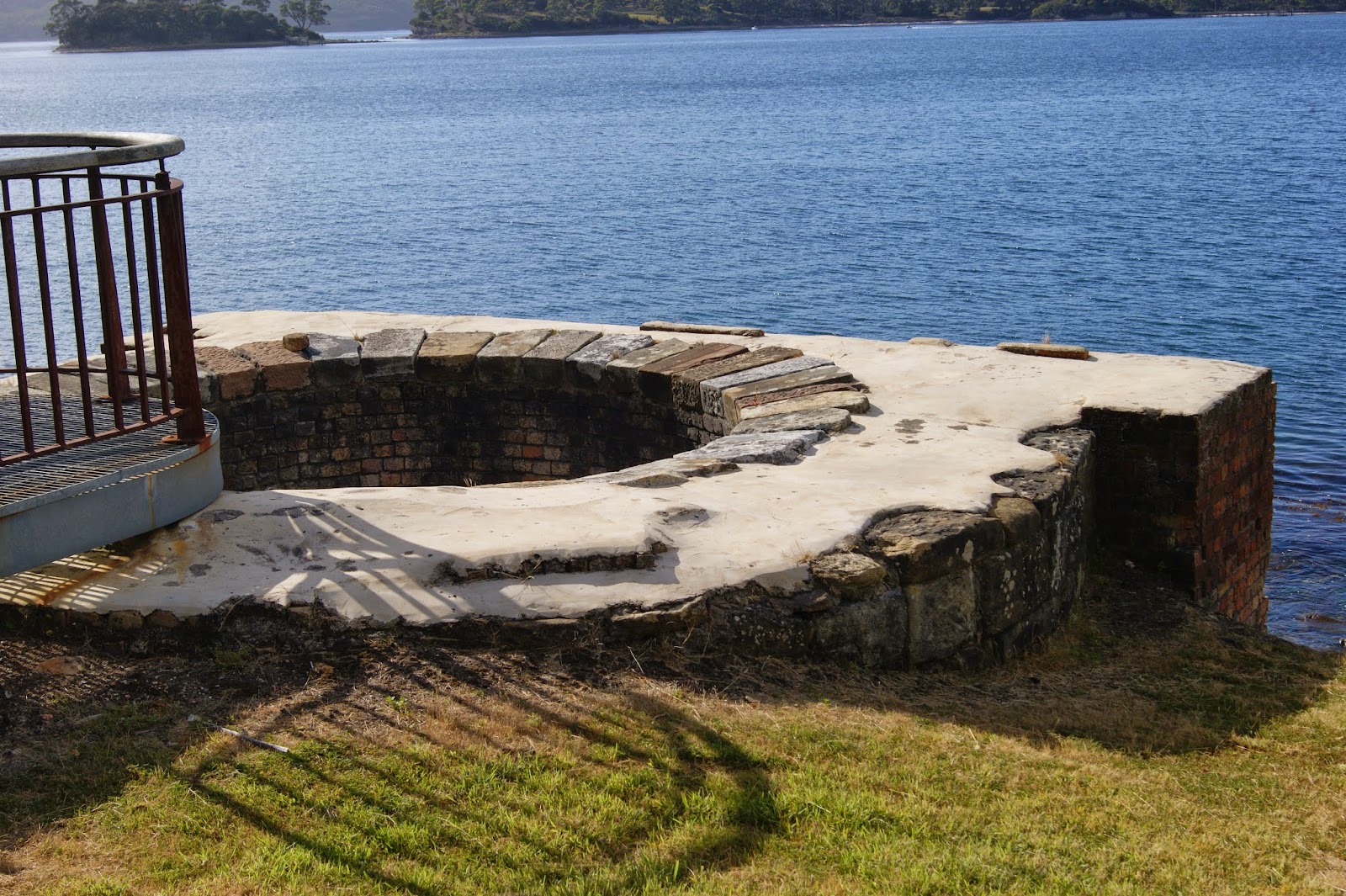
Throughout colonial Australia, only three dockyards used convict labour to build both the yards and the ships. The Port Arthur Dockyard was one of them. The other two were Sarah Island on Tasmania’s west coast, which closed just as this yard opened, and the first Sydney dockyard. Opened in 1834, the Port Arthur Dockyard mainly supplied and repaired ships for the government. It also repaired some private vessels. It was located away from the main settlement, to reduce the ‘corrupting communication’ between convicts and free sailors.

The work force built a great variety of maritime craft including barques, brigs, schooners, cutters and whaleboats. These vessels transported convicts, supplies, raw materials and manufactured goods between Port Arthur and other colonial ports. The men here built some of the biggest ships in the colony at that time. A free Master Shipwright and convict overseers directed production in the yard. Up to 70 adult convicts and boys from Point Puer formed the labour force.

Like all the work sites at Port Arthur, it served two purposes. The hard work was meant to help reform the men, but their labour was also expected to be as productive as possible. Men who were sentenced to hard labour worked in gangs, carrying timber; well-behaved men were given the opportunity to learn a trade. You might imagine that men forced to labour work reluctantly, resentfully and slowly, and take no pride in their work. But these convict-built ships were as good as any built in the colony.

John Watson was the Master Shipwright until 1836. He was followed by David Hoy. Both men seem to have taken seriously their responsibility to reform the convicts under their charge. John Watson’s grandson described how his grandfather had taken a ‘very desperate character’ and turned him into a productive worker by treating him ‘like a human being and not as a caged beast’. In general Watson found the men, no matter how ‘dangerous’ and desperate’ their reputation, ‘most willing to learn a trade and some of the boys turned out very well’. David Hoy also enjoyed a good relationship with his workers, and was proud that many of them became ‘respectable and useful’ members of colonial society. Walter Paisley, who learned his trade here as a very rebellious Point Puer boy, was still making whaleboats 50 years later.

There were two docks for large vessels and a slip for smaller boats. These were the focus of all Dockyard activity. One of the large docks, dug by convicts in 1835, is still visible, though a limekiln was built in the other in 1854. The small slip is no longer visible. 15 large vessels, the biggest weighing 286 tons and measuring 30 metres long, and more than 140 smaller boats were launched from these docks. Much of the activity took place on the water. When the hull of a vessel was completed, it was launched and anchored offshore; there the fit-out of the decks, mast and rigging continued. Small boats and barges ferried men and materials between the ship and shore. When vessels pulled into Port Arthur for repair, they were sometimes careened in shallow water on the rocks so that men could work on the bottom of the vessel. Men engaged in these repairs often worked in water up to their necks.

The Master Shipwrights House was one of the first buildings in the Dockyard, built for John Watson and his family in 1834. It was not only his home, but his office, the ‘nerve centre’ of the Dockyard. From its windows he could survey all its activities. Here ships were designed, records were kept and orders were given. A convict clerk worked in the toolstore next to the kitchen, issuing the valuable tools and keeping the accounts. John Watson left in 1836 and was replaced by David Hoy.

Hoy had been at Macquarie Harbour for six years, where he had been in charge of shipbuilding with ‘no assistance but from prisoners taken out of the gangs, only one or two of which had ever handled a sharp-edged tool’. He claimed to have turned them into shipwrights equal to any in the colony in three years. His personal history illustrates the dangers of working in a 19th-century dockyard. He injured his back when spars fell on him at Macquarie Harbour, and fractured his skull after scaffolding collapsed under him at Port Arthur. When Lady Franklin met him in 1837 she described him as ‘an old man’. He was then about 50.

The Master Shipwright’s house is the only building that survives from the ship-building period. It is built using brick-nogged construction, an old technique that creates a strong and well insulated structure. The house was once surrounded by outbuildings – a pig sty, poultry shed, store, privy and laundry. The small garden in front was probably the shipwright’s wife’s domain, where she grew flowers and herbs.

Behind the house lay the large food garden. When the Dockyard closed in 1848 this house was occupied by a succession of civil officers, including the commissariat officer and the schoolteacher. After Port Arthur closed, the house passed into private hands but was resumed by the government in the 1950s. It narrowly escaped demolition in the 1970s

Up to five convict overseers worked at the Dockyard. They ensured that the convict work force carried out its orders. Master Shipwright David Hoy employed a number of free men as overseers to try to improve discipline. Port Arthur’s military garrison was responsible for security. Boats and tools were a tempting target for would-be escapees, so three soldiers were stationed at the Dockyard on watch each night. According to regulations, they were to be ‘most vigilant that nothing is taken away; to take into custody any prisoner lurking about his post or out of the Master Shipwright’s quarters without bearing a written pass, to hail all boats passing and repassing; to be most careful that no fires are left burning, not to quit their post except for the purpose of reporting anything extraordinary they may have observed, to keep an eye on anything they observed floating or drifting in the water.

The Sentinel is not to enter the hut in his hours of duty, to patrol frequently about the yard during his hour, his attention to be particularly directed to any boats that are ready for launching, to answer the Sentinel’s call of ‘all’s well’ at the settlement every half hour’. Despite these precautions, four prisoners stole a boat from the Dockyard and escaped in 1835. They were later recaptured.

The Clerk Of Works House is not part of the former Dockyard complex, but was built over the top of the 1841 Blacksmiths’ Shop and an earlier sawpit. The house was constructed after 1848 and was occupied by a number of officials during Port Arthur’s later years, including a chaplain and the clerk of works. After the settlement closed the house was privately owned.

Though successful, the ship building operations at Port Arthur ceased on a large scale in 1848. A growing colonial economy, recovering after a severe depression in the early 1840s, meant that private ship builders did not want to compete against a government yard producing ships at a cheaper rate and lobbied for its closure. During its 15 years of operation, Port Arthur’s dockyard produced 15 large decked vessels and around 150 small open boats. At its peak, more than 70 men worked here.

Today this area is silent and almost empty. But if you had been here between 1834 and 1848 you would have seen a collection of small and large wooden sheds clustered around two large docks. In the largest shed, a vessel 25 metres long is taking shape. On a small slip nearby a whaleboat has been drawn up for repairs. Around these vessels swarm men in coarse woollen uniforms, with brown leather caps on their heads. Other men work up to their necks in the cold water, repairing another vessel just off shore.

A timber-carrying gang is emerging from the bush, bringing a log to the sawpits. Other convicts sweat in the heat of the blacksmith’s shop, forging iron and copper fittings for the ships. You would have heard the rasp of saws, the clash of metal on metal, men shouting to one another. You would have smelt sawn timber, burning charcoal and hot pitch. Today only bird song and the sweet smell of the bush fill the air.

Main Text & Information Source – Port Arthur Shipyard Guide