Tuesday, 19 March 2013

Henry Jones IXL Jam Factory


Henry Jones was born on the 19th of July 1862. His parents John and Emma were originally convicts who were sent out two years apart and served their sentences separately and ended up getting married some time later. At the age of 12 young Henry Jones started work for George Peacock his first and only employer. Working six days a week, ten hours a day Henry Jones pasted labels on jam tins. At the age of 27, he purchased a share of the factory and then from these humble beginnings, rose to fame as an entrepreneur spanning five continents with interests in jam, fruit, timber, mining and shipping.


George Peacock began business in Hobart as a jam manufacturer in 1861. He bought Nos.31 and 33 Hunter Street, a pair of dilapidated warehouses in 1869, expanding to No's.27 and 29 by 1882 and a reinforced concrete warehouse was built in 1911. The fabric of the largest part of the building is of reinforced concrete and is founded on timber piles under the greater part of its area.  When it was built, the technology of reinforced concrete was quite new and this was one of the first constructions using the material in Australia. Later just before 1895, George Peacock transferred his jam making interests to Henry Jones – one of his employees.


All this originated in the buildings now comprising the Henry Jones Art Hotel. This group of buildings is located on what was once Hunter Island which was used in 1804 by Lieutenant David Collins, for landing and receiving of stores. The island was connected to the foreshore by a causeway in about 1820 and a warehouse was erected shortly after. The line of the causeway is marked by bronze markers in front of the present buildings. Because of insufficient depth and difficult docking conditions for vessels under sail, shipping transferred to the New Wharf at Salamanca Place. However, with the coming of steam, shipping returned and Hunter Island was developed with land reclamation.


Over the next forty years the premises of the Jones & Co. jam factory extended in both directions along Hunter Street. In 1903 the two warehouses next to No.33 were either substantially altered or demolished to make way for the Ice works and the Cool Store. In 1911, the remaining old warehouses at the eastern end of Hunter Street were demolished and replaced by the large concrete building now occupied by the Centre for the Arts. An article published in 1922 attributed much of the company’s success to the self-contained nature of the company as everything required by the company was produced by it, from the timber for the packing cases to the equipment necessary to manufacture the specialist machinery used in the factory. 

The old warehouses at 27-33 Hunter Street were used primarily in the production of the tin containers used for canning jam, preserved fruit and fruit pulp. The 1922 article described the tin-making operations as they were then practiced in considerable detail and discussions with past employees suggest that the processes varied little over the years.


Henry Jones and Co’s company motto ‘IXL’ dates from about 1895 and, it is said, derived from Henry’s own quote “I excel, in all the products I make”. As a brand name this motto was an inspired choice soon forming part of Tasmanian and Australian folklore. It became instantly recognizable with the man, his factories and his products. He was the largest private employer in Tasmania and at the time, the head of the largest private company in the world exporting jam to countries throughout the world. A comment in the press of the day stated “The works are comprised in a splendid block of buildings situated on the Old Wharf, including newly-erected brick premise, having 160 feet frontage by 80 feet depth, with iron roof and splendidly lighted and ventilated. 


The works were almost entirely refitted in 1898 and only the most modern and up to date machinery was now used in all departments. A new 50-horse power boiler was erected by Kennedy and Sons of Hobart, and there was another boiler of 30 horse power, the two supplying the motive power for driving all the machinery including that employed in the manufacture of packing cases, tins etc. The entire premises were constructed of stone and brick, of three storeys, with a frontage of 300 feet by a depth of about 290 feet, and a floor space of 140,000 square feet. 


In the boiling room there were seventeen large copper boilers in which the jam was made. It was said that during the fruit season, the room would be thick with steam and the air full of the fragrance of boiling fruit. The smell wafted into the city and Hobart residents might knowingly remark “Yes, it was apricot jam today”. Messrs H. Jones & Co. used no fewer than 2,000,000 tins each season, which were all made on the premises. The IXL factory employed between 150-350 workers, according to the season of the year…’


Henry Jones died in 1926 and over 5,000 mourners went to his funeral. Jam however was made through to 1979 when the factory closed down and the brand had become synonymous with quality Australian jams & preserves. The IXL business was purchased by Elders to become Elders IXL. Much of the factory area still stands in Hunter St and parts have been converted into cafés, art galleries, office space and the Henry Jones Art Hotel.


Updated 22/5/2016
Updated Information Source - www.abc.net.au - 23/7/2015

Sunday, 17 March 2013

Royal Engineers Building, Hobart


This Gothic Revival style building was constructed in 1846-47 to house the senior members of the Royal Engineers, who were responsible for arranging all works in the colony. Designer unknown, the building is of sandstone front and facings, with brick sides and rear, which were subsequently cement rendered.  An interesting feature of the building is that two of the windows on the northern side are false and appear to be windows from the outside only. The large area of Crown Land included the engineers’ parade ground, workshops, houses and, earlier, works stores, timber yard and jetty, much of which dated from John Lee Archer’s time as engineer and colonial architect from 1827 to 1838.

The Tasmanian Main Line Railway Company, which built the railway from Hobart to Western Junction (and modified the line to Launceston) from 1873 and operated it from 1876, occupied the building as its headquarters until the State Government acquired the company’s assets in 1890. The building continued as railway headquarters until the Transport Commission was established in 1938. It subsequently became the railway’s printers and stationery store.

More recently, the building was acquired by the State Government and restored with funds from Government grants, gifts from professional engineering organizations and public subscription. The building is currently leased by the Institution of Engineers, Australia, and occupied as headquarters of its Tasmania division and is situated at 2 Davey Street, Hobart, opposite the Gasworks Village area.


Friday, 8 March 2013

Ross Village


First surveyed in 1807 by Government Surveyor Charles Grimes, who traced sections of the river.  Governor Macquarie, inspired by the findings, visited in 1811 and named the area Argyle Plains and the river Macquarie. On his second journey through central Tasmania, Macquarie chose the location beside the river for a township
In 1812 a garrison of soldiers was stationed at the ford of the Macquarie River to protect the development of this future town.  Other buildings were soon built and in 1821 the settlement was proclaimed the town of Ross.  Governor Macquarie called it Ross after the home of his friend H.M. Buchanan who lived on Loch Lomond in Scotland. At that time the river was forded. Later that year a wooden bridge was built and by 1836 the stone bridge, one of the finest in Australia, was completed.  Ross was considered ideally situated being centrally located and easily accessible from both North and South.  The good flat country was ideal for farming and so for supplying food and the river provided a reliable water supply.  Indeed in those early years of the colony, the government operated a large farm in the district for agriculture and breeding of draft oxen.  It was broken up in 1830 and sold off to private landholders.

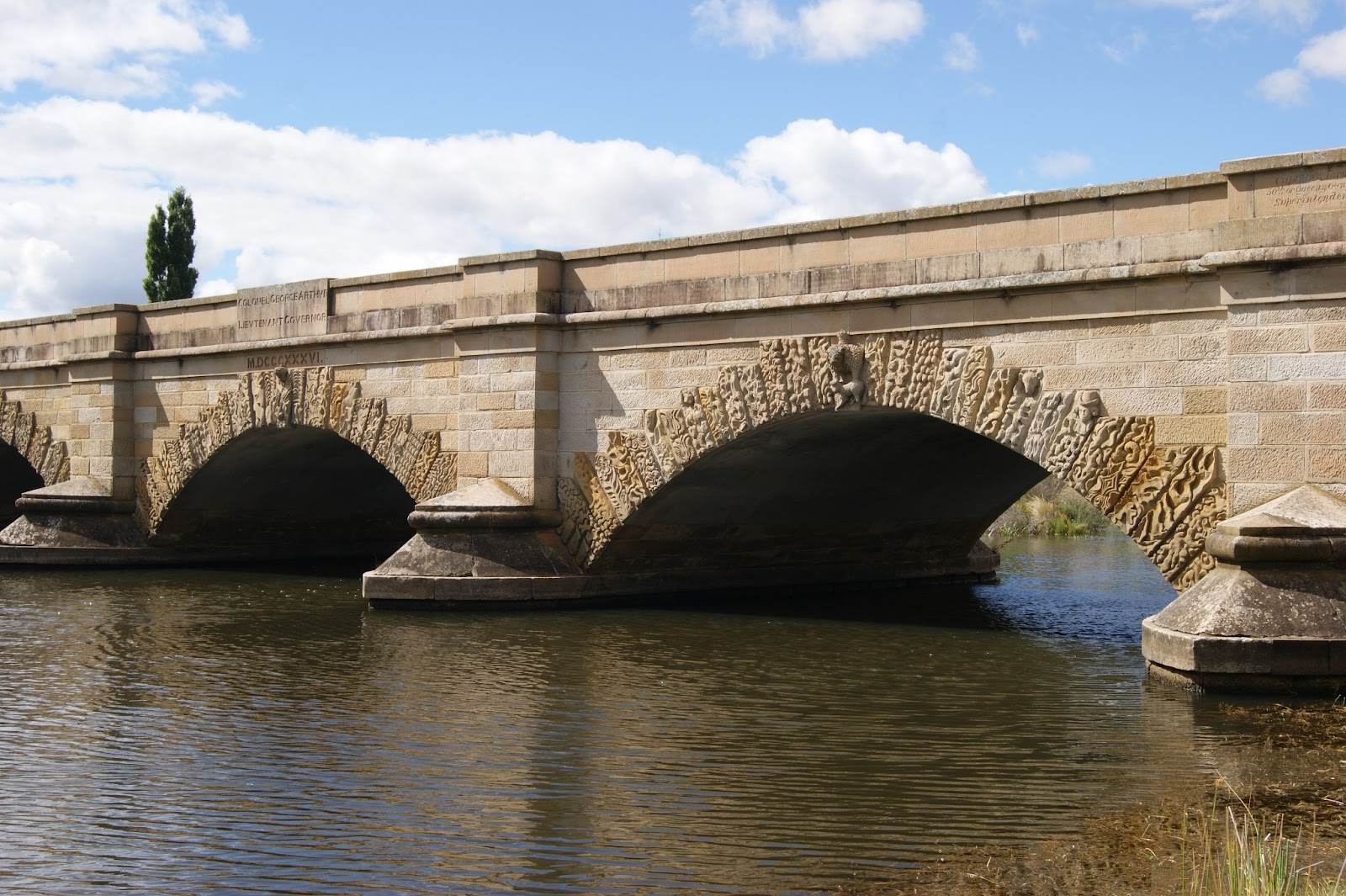
The Macquarie River was originally crossed by a ford at Ross.  In 1821 a low level bridge was built consisting of logs laid on some stone buttresses and covered with earth and gravel.  In 1836 this was replaced by the splendid sandstone bridge which is still one of the historic features of Ross today. Quite rightly the pride of the village, this beautiful stone bridge was constructed by convicts in 1836. It is the third oldest bridge still standing in Australia and is recognized as the most important convict-built bridge in the country. It was constructed on the orders of Governor Arthur and designed by John Lee Archer. 

Built by convicts its beautiful stonework is the result of two convict stonemasons - Daniel Herbert and James Colbeck. They were paid one shilling a day. Herbert, who had been transported for highway robbery in 1827, was freed after the bridge was completed and is buried in the Old Cemetery. He is credited with the beautiful carvings on the side of the bridge. Experts have described the carvings as 'possibly the richest achievement of the earlier colonial period if not the most significant sculpture on any edifice in the Commonwealth. Leslie Greener, who was largely responsible for discovering that Daniel Herbert was responsible for the carvings, has written: 'Ross Bridge is the most beautiful of its kind today. The carvings have in them that delight in the shapes themselves that our sculptors lost somewhere in the 13th century’

The military presence remained an important part of Ross for many of its early years and its influence can still be seen today.  A number of the early buildings around the town have military origins and several streets are named after battles of the Napoleonic wars.  Some of the military stationed here in those early days were veterans of these campaigns. As Ross developed it became important not only as a garrison town but also as a coach horse change and livestock market.  In 1826 it became the venue for the first agricultural show in the midlands.  These beginnings are evident in the coaching inns and the fine properties in the surrounding district.

It also became the site of one of four Female Factories opened in Tasmania and operated from 1848 – 1855. The site of the Ross Female Factory can still be visited and although very little physical architecture remains in place, it is still considered one of the most archeologically intact female convict sites in Australia.

Tasmania has an excess of beautiful and fascinating 19th century colonial towns. Places like Campbell Town and Richmond are famous for their gift shops, their pretty vistas and their overt tourist appeal. But, of all the early 19th towns, there is nothing quite the equal of Ross. The secret is that the Midland Highway (the main route between Hobart and Launceston) by-passes Ross thus preserving the original, sleepy character of the town. Tasmania was a draw card for early European settlement for several reasons. Access to the southern waters for seals and whales was one. Excellent farming districts for stock and grain to feed the rest of the colony added to the appeal to settle. The third reason, the island was ideal to send convicts to. The size allowed security of the convicts to be more manageable. 

A road was needed between the North and South of the state. White man had discovered the original aboriginal inhabitants had already carved trade routes throughout the state. One such trade route was between the Launceston district in the North and the "Hobart Town" district in the South. This trade route is now called the "Heritage Highway". The best source of labour to construct the road was convicts. The cheapest convicts to use needed less supervision, so low security convicts were used. Places like Ross were set up at river crossings along the route. The convicts could build and maintain the road and river crossing (in this case the famous convict built bridge). 

The convicts also had to build the accommodation for themselves and the officers in the village. As sandstone was more readily available than other building materials, a lasting legacy of convict built sandstone buildings now provide the visitor with an amazing experience. These early European settlers aimed at recreating a familiar environment to them. It is no mistake that the village is English in style complete with English Elms, cottage gardens and quaint Georgian style cottages.

Throughout the nineteenth century Ross was an important stopover point between Launceston and Hobart. As such it was a horse coach changing point, a town for the local garrison and an important destination for produce from the surrounding farms. The main crossroad in Ross is known, with some humour, as Temptation, Recreation, Salvation and Damnation. The reason for this combination is that on one corner (Temptation) stood the Man-O-Ross Hotel, on another corner (Salvation) was the Roman Catholic Church, on the third corner was the Town Hall (Recreation) and on the fourth stood the Jail (Damnation).  The field gun in the middle of the crossroads was actually used during the Boer War.

Today it is arguably the finest nineteenth century village in Australia. It has resisted the excesses of commercialism and the combination of the tree-lined main street, the beautiful bridge and river and the location of the Wesleyan Church at the top of the slight hill, combine to give it a remarkable aesthetic beauty and tranquility. 

The great quality of Ross is that it has not been overly corrupted by modern tourism. The town is very typically English and, with its warm Ross sandstone, is reminiscent of the towns which can be seen in the Cotswolds or in north Oxfordshire. In many ways Ross is a town which has stopped in time. It is beautifully preserved.


Sunday, 3 March 2013

Oyster Cove Aboriginal Settlement

The buildings at Oyster Cove were originally built in 1843 on unhealthy mudflats with insufficient drainage and little fishing. The buildings were of wood which soon rotted and offered little protection from the icy winds coming from the south. Initially the station was used for white female convicts and later for male convicts. It was abandoned in 1847 when it was found to be unsuited to convicts but was deemed still suitable for Tasmanian aborigines


In 1847, 47 Tasmanian Aboriginal people, incarcerated for fifteen years at Wybalenna on Flinders Island, arrived to take up forced residency at Oyster Cove station, the ex-convict government settlement 35 miles south of Hobart. The arrivals consisted of 5 boys, 5 girls, 23 women and 14 men, all who remained of some 200 Tasmanian Aboriginal people who had been compulsorily and officially removed from across Tasmania. Their return was officially recorded as a budgetary measure, but could also be viewed as a means to allay guilt for what non-Aboriginal people viewed as the 'last' of a distinct race dying outside their home territory to which they had continually asked to return. Initially delighted by the freshly painted houses, tables, bed, chairs and glass windows, the Tasmanians (who had not enjoyed such luxuries at Wybalenna) in turn delighted the settlers of the area with their ceremonial dances. The houses were arranged around a square and the 11 couples lived on one side while the unmarried people lived on the other. The ten children did not live at Oyster Cove but were sent to an orphan school at Hobart. The joy did not last.


The authorities had learnt a little from the disaster that was Wybalenna. While regular inspections and better food and other supplies made for a good start, the relentless cultural pressure to turn the aborigines into subservient British servants together with the unhealthy conditions at Oyster cove made life unhappy for the aborigines. In the opinion of what were still in fact, British jailers, the aborigines developed too much independence - some even had the ‘nerve to built their own huts and plant their own food!’ Some women also preferred to prostitute themselves so they could buy alcohol rather than attend the interminable religious instructions. Men also preferred to drink or go hunting in the bush despite the risk that this entailed. The jailers regarded all such independent activities as "recklessness" and "rank ingratitude".

There was a fair degree of outrage at the return to mainland Tasmania of its original inhabitants. Tasmanian pastoralists recalled a history of bloody skirmishes, and held a special meeting to protest the return of  the indigenous peoples to their traditional homelands. In part responding to these fears, the government described the non-threatening state of the thirteen Aboriginal men, saying they had either been reared by Europeans or worked for them, had lived for fifteen years 'in civilized habits' and 'are almost all addicted to gardening'. On arrival, eight children were removed to the Queen's Orphan Asylum in Hobart, and it is not known what eventually became of four of them.  

In bringing this group of mostly aged or incapacitated Aboriginal people back to mainland Tasmania, the government disregarded the growing population of Aboriginal people living across the Bass Strait Islands but outside the official Wybalenna settlement. These outcasts were considered separate because of their parentage, language and customs. These differences provided the means of exclusion from any recompense due for their own, their parents' and their grandparents' losses, including country, resulting from European invasion.

Upon arrival at Oyster Cove, the newcomers performed ceremonies. This may have boded well except that the site was damp and unhealthy, proper maintenance was never undertaken, provisions were poor and non-Aboriginal administration was inadequate. Local game was eliminated rapidly. Over the next few years the Aboriginal population declined in health, spirit and number, though some undertook extended hunting trips, in one instance to South Cape in 1848 and another walking to Port Davey during a six-week absence in 1860.

Other activities included general hunting and food gathering, traditional medicinal practices, diving on wrecks to procure lost goods for payment, fishing, shell necklace making and fibre practices, gardening, collecting firewood, frequenting local taverns, tending their thirty dogs, being constantly visited by outsiders and occasionally attending events in Hobart town. Five men went on whaling voyages. By 1851, 13 of the 46 had passed away. In 1855 John Dandridge took charge and improved care, despite the government halving its expenditure. This kindness was too little, too late and the population continued to decline. By 1859 only twelve people remained.

Oyster Cove was occupied by Aboriginal people until it succumbed to heavy flooding in the winter of 1874. The site was then abandoned. The last remaining full blooded Aboriginal inhabitant, Truganini, a Nuenone woman whose country was Bruny Island opposite Oyster Cove, was moved to Hobart and lived for the remaining two years of her life with Mrs Dandridge, wife of the former superintendent.

Oyster Cove today symbolizes the unity and resolve of Tasmanian Aboriginal people to redress wrongs of the past by political means. In 1981, the state government proclaimed 30.3 hectares of the Oyster Cove Station a historic site. In 1984 the Tasmanian Aboriginal Centre occupied Oyster Cove and claimed land rights for the site. After several attempts, in 1995, 10 hectares at Oyster Cove were among the 3800 hectares transferred to the Tasmanian Aboriginal people.

Today, Oyster Cove is a peaceful place, surprising considering its fraught history. No buildings from the settlement have survived the ravages of time. Each year the Tasmanian Aboriginal Centre hosts the Oyster Cove Festival – a day of community, music, food and remembrance. Having this place, where many of the Old People spent their last days, under Aboriginal care is an affirmation of the cultural and spiritual responsibility of Aboriginal people to maintain and build relationships with their people and country.