Sunday, 14 September 2014

Sir John Franklin's Lost Ship Discovered

One of the greatest mysteries of the Victorian era of exploration has been solved this week, with the remains of former Tasmanian Lieutenant-Governor Sir John Franklin’s ill-fated 1845 voyage to the Northwest Passage discovered on the ocean floor off Canada. Canadian Prime Minister Stephen Harper recently announced sonar had captured images of one of the vessels, following a government-sponsored hunt that began in 2008. The discovery of the wreck was confirmed on Sunday, Sept. 7, 2014, using a remotely operated underwater vehicle recently acquired by Parks Canada. Details of where exactly the ship was found have not yet been released.

Sonar Image - Parks Canada

In 1845, celebrated former Tasmanian lieutenant Governor Sir John Franklin vanished during a voyage on the edge of the Arctic Circle north of Canada. Sir John Franklin led the two ships and 129 men in 1845 to chart the Northwest Passage in the Canadian Arctic. The expedition's disappearance shortly after became one of the great mysteries of the age of Victorian exploration. Franklin, who served as a reformist leader of island colony from 1836 until his removal in 1843, led an expedition of two ships and 129 men to the Arctic two years later but the explorers vanished soon after.

Sonar Image - Parks Canada

Franklin was searching for a way through the Northwest Passage, hoping to find a northern sea link between the Pacific and Atlantic Oceans. The loss of HMS Erebus and HMS Terror prompted one of largest searches in history, running from 1848 to 1859. The mystery has gripped people for generations, in part because no one knows for sure exactly what happened to the crew. Experts believe the ships were lost when they became locked in the ice near King William Island and that the crews abandoned them in a hopeless bid to reach safety.

Sir John Franklin's wife spearheaded an attempt to find him, launching five ships in search of her husband and even leaving cans of food on the ice in the desperate hope he would find them. Stories gleaned from the local indigenous people, the Inuits, suggest the expedition became locked in ice and perished. In desperation, it was claimed the stranded party resorted to cannibalism. However, Lady Jane Franklin refused to accept her husband met such a horrid fate and continued raising money to fund searches many years after he was last heard from and long after most authorities had given up hope of his survival. Despite a great number of search expeditions over the following decade, no sign had ever found of the HMS Erebus or the HMS Terror.

Three bodies discovered over a century later in the 1980s were found to have a high lead content and to this day, many people believe the 129 crew members were poisoned by leaking lead in their poorly soldered tin cans. More recent research suggests the canned food supplied to Franklin was not acidic enough for that to happen and the lead was more likely to have come from the internal pipe system on the ships.

The search resulted in the discovery of the Northwest Passage, which runs from the Atlantic to the Pacific through the Arctic Archipelago. The discovery of Franklin's vessels is considered one of the most sought-after prizes in marine archaeology. A team of Canadian divers and archaeologists has been trying to find the ships since 2008.

Sir John and Lady Jane were in Van Diemen’s Land between 1836 and 1843 and left an enormous legacy, establishing a museum, university and helping develop the island’s reputation beyond that of a penal colony. Their contribution to Tasmanian society is significant and positive. Franklin’s legacy is still visible in Tasmania today, with both a river and village named after him and his wife, his statue a prominent feature of Hobart’s Franklin Square, while University of Tasmania residential college Jane Franklin Hall was named after his widow.

Main Text written by Duncan Abey - “The Mercury” newspaper, September 11 2014
Extra text from BBC World news - Fabled Arctic Ship Found
Extra text from “The Mercury” September 11 2014 - Ice Thaws on Franklin Find

Sir John Franklin Biographies & Historic Photos
Wikipedia - Sir John Franklin
Australian Dictionary of Biography - Sir John Franklin

Alison Alexander’s Book – The Ambition of Jane Franklin - Jane Franklin


Video from CBC's "The National" Youtube Channel

Wednesday, 10 September 2014

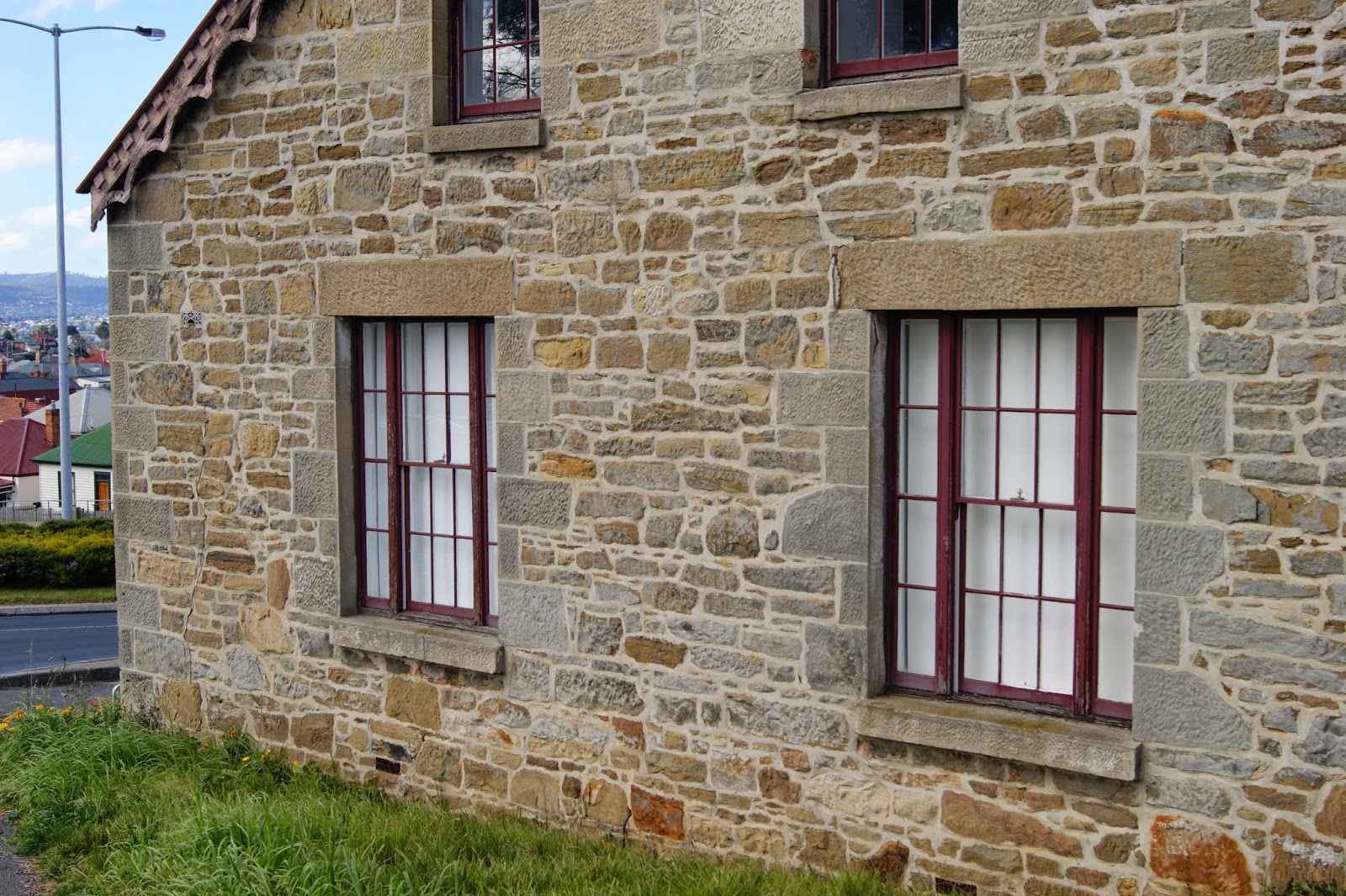
Gatesheath Cottage

Thomas Hodgson Bromfield was a prominent member of a family of well known schoolmasters in Hobart Town in the early to mid 1800's. By 1845, he was proprietor of a school based in Roxburgh House in Elizabeth Street. he continued in this role for some time until in August 1863, he purchased the corner block of what was known as the "Limekilns Reserve" subdivision at the top end of Murray street. According to the Government gazette, the area was named after the Government Limekilns that has operated in the area since 1816.

On his newly acquired Murray Street lot, Bromfield built his new school building and called it the "Tasmanian Academy". For many years after this, his school enjoyed a very sound reputation. Gatesheath has one particularly extraordinary feature inside. There is a single large room on the right hand side of the short hallway. It is broad, extending the full width of the house and takes up nearly half of the available ground floor area. There is a very good reason for this feature. The extra large room was the original classroom.

Many years later, when Bromfield's grandson. Mr F.C.L. Alcock, owned Gatesheath, it was also known as "The Dairy" because he worked as a milk vendor and customers would often come around to pick up their milk from the house.

Gatesheath is an excellent example of a basic simple design. Steep stairs inside lead up to 4 well lit rooms that are not visible from the Murray street approach. The house apparently remained in the Alcock family until 1989 when it was sold as part of a deceased estate. The house now remains in private ownership.

It is a beautiful looking cottage and sits in a very prominent position at the intersection roundabout of Murray Street & Burnett Street.

Main Information & Text Sources -
“Mansions, Cottages and All Saints” – Book by Audrey Holiday & Walter Eastman
&

Sunday, 7 September 2014

The Old Rectory & The Dispensary

The Old Rectory is a large two storey Georgian Colonial house set in 4ha of grounds in Richmond. Also set in the grounds is a small two room stone cottage used in the 1850s by Dr John Coverdale as his dispensary. This two-storey stone mansion was reputedly built by James Gordon who was the Police Magistrate for Richmond between September 1829 and March 1832.

By 1835 the property was owned by John Halls who mortgaged it for ₤700 at 15% interest. In September 1838 the property was purchased by William Henry Breton for ₤1,900.  Breton was Police Magistrate for Richmond between December 1835 and April 1841.  Breton subsequently became the Police Magistrate for Launceston and he rented out the house until May 1854 when he sold it to Dr John Coverdale.

Coverdale was born in India and studied medicine at Glasgow, Scotland before coming to Australia.  He arrived in Hobart around 1837 and moved to Richmond a few years later and established a medical practice. Coverdale reputedly used the compact stone building that is today’s 11 Edward Street as his dispensary.

In 1861 the Richmond Municipal Council was created and Coverdale topped the poll at its first election.  His fellow councillors elected him warden and he retained this position until 1864 when he left the district to become the surgeon superintendent of the Queen’s Asylum for Orphans at New Town.  Coverdale leased out the property to the successors to his medical practice – Dr Charles Turner and later Dr William Allnutt.

Coverdale died in June 1896 and his properties in Richmond were sold at auction in April 1901.  The notice in The Mercury described his Edward Street property as ‘a valuable allotment of land … together with the large stone two-storey dwelling house, with stables, outbuildings, garden, and paddock.’  The property was purchased on behalf of the Church of England in Tasmania ‘for a parsonage and dwelling house for the use of the Incumbent or Curate in charge for the time being of the Parish Church of St Luke situated in Richmond.’

Today’s 11 Edward Street (the old dispensary) was sold off as a private residence in November 1904 but today’s 15 Edward Street remained the rectory for St Luke’s until the early 1970s. Both properties remain private residences to this day and both appear to be in wonderful condition considering their age.

Main Text & Information Source – Australian Heritage Database

Wednesday, 3 September 2014

Oak Lodge, Richmond

Oak Lodge was built by Henry Buscombe, the younger brother of James Kestall Buscome who was responsible for the building of several prominent Richmond landmarks, including Prospect House & the Old Post Office. Henry had joined his brother in Van Diemen's Land in October 1830. By March 1831, he had applied for a first class allotment of land in Richmond in the area where Oak Lodge now stands. According to his application, Buscombe intended to erect a stone or brick dwelling house of not less than 50 feet deep, to have the property fenced with a good post & rail fence and to make a series of other suitable improvements to the land. The application was subsequently approved.

The house was probably built between 1831 & 1842 as a building appears in its location in a survey of Richmond undertaken in 1842. In the census of 1842, Buscombe claimed the building had been completed and were inhabited with two residents and two servants.

In 1843, Buscombe sold the property to Captain James Richard Booth, who was the brother of the former commandant of the Port Arthur convict settlement, Charles O'Hara Booth. The House was referred to locally as the "Commandants House" due to this connection. Booth, however, named the property "Basing Lodge" after the family residence in Basingstoke, Southampton. The property was only named "Oak Lodge" following Booth's departure in 1846 when he returned to England and Basing Lodge was leased out.

In June 1852, the property was advertised for sale, at which time it was being leased to the Rev. W. Tancred. The description of the property in the advertisement makes for very interesting reading. "That commodious family residence on the corner of Blair & Bridge Streets....These substantial premises are newly built, and having been intended for the residence of the proprietor (Captain Booth R.N) every convenience is attached and no expense has been spared in making them complete in every respect. The house, which is two stories high, comprises fourteen rooms with six on the ground floor, with capital cellars under, five bedrooms on the second and three spacious servants rooms above" Given the five different levels comprising Oak Lodge, it is quite possible that Booth had added substantially to Buscombe's earlier construction.

In 1855, Oak Lodge became the home of Rev David Galer of St Luke's Church, Richmond. The church, at the time, had no purpose built rectory for the accommodation of the Reverend. Rev Galer lived in the residence for nearly twenty years until he put the property on the market. The property wasnt sold until 1880 when William Stevens, a schoolmaster of Richmond, and Mary Bedgood (a widow and presumably Steven's sister) purchased the house and ultimately resided in Oak Lodge until 1909. In May 1909 Oak Lodge was conveyed from Mary Bedgood to Arthur Ogilvy of Richmond.

Ogilvy did not live in the house, instead renting it out to Dr William Clark, the towns noted American born Doctor. Dr Clark remained the tenant throughout the period through to 1950. There had been a number of owners during this period including James Montegu Butler, a solicitor who purchased the property in 1940. Dr Clark had left the USA in 1891 for Australia. before settling in Richmond, he had practised in Launceston, Hobart and the Huon region. He lived and worked at Oak Lodge from 1909 until the late 1940's.

The final owners of Oak Lodge, the Horsfall sisters purchased the property from Butler in 1962. Miss Murel Horsfall ultimately gave the house and much of its contents to the National Trust in 1998. The two most significant trees on the property are the two magnificent English Oak trees in the front of the house, which gives Oak Lodge its name. Oak Lodge has been used as a rectory, a school, a doctors surgery and a family home.

Oak Lodge is still owned by the National Trust (Tasmania) and is operated and maintained by the volunteers of the Coal River Valley Historical Society Inc. The society has developed a number of wonderful displays within the different rooms of the house and the volunteers have done a wonderful job maintaining the house as a museum and wonderful example of a bygone era in the Richmond region.

You can visit this National Trust-listed property to gain insight into early colonial life, explore the well-preserved rooms and stroll in the original nineteenth century garden. Oak Lodge is open daily (except Christmas Day, Boxing Day and Good Friday) from 11:30am until 3:30pm. Entry is $4 per adult & $1 per child and is free to National Trust members.

Main Text & Information Source - 
Oak Lodge Information brochure (Produced by The Coal River Valley Historical Society)
Oak Lodge - Saving Oak Lodge
Coal River Valley Historical Society

Information updated 5th October 2014. Thank you to Neville Mendham for updated information.