Welcome to Historic Church's Month.
All Posts this month will feature some of Tasmania's most beautiful and interesting Historic Church's
The island of Tasmania is studded with attractive little churches which stand as a witness to the keen desire of the early pioneers to perpetuate the Faith of their Fathers in their new homeland. One such church is the Church of St Matthias, Windermere, which owes its foundation to Dr. Mattheus Gaunt, who arrived in Tasmania (then known as Van Diemen’s Land) by the ship ‘Eliza’, from London on May 2nd 1831. He was accompanied by his wife and five sons.

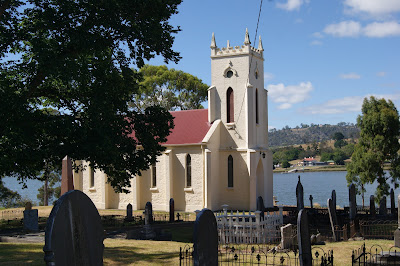
Dr. Gaunt received a grant of 2,560 acres on the east bank of the River Tamar, and this property he named ‘Windermere’. The property was later extended by a further grant of 1,280 acres. Dr. Gaunt fulfilled a promise made to his wife before they left England to provide a church if there was none where they settled, when he gave the site and set about the erection of a church at Windermere. True to his promise, Gaunt set aside a portion of his land and engaged his new friend and neighbor, Robert De Little, an architect, to design St Matthias’ Church and supervise construction. The builder was Henry Howard.


Aided by a local subscription of £60 and a grant of £40 from the Society for Promotion of Christian Knowledge (England) and settlers on both sides of the river who were also eager to contribute in order to have a church of their own, Gaunt financed the building of the church which was begun in 1842 and completed in 1843. The local newspaper reports that one boat from Launceston laden with bricks for the church was sunk in deep water just before reaching Windermere. It is possible that convict labour was used in the erection.


In November 1843, the Archdeacon of Launceston, the Rev. Dr. D.W.H Browne, conducted the service at which the church was opened for public worship. Occasional services were then held in the Church, when the Rev. T.H. Forster officiated. On April 18th, 1845, the first Bishop of Tasmania, The Rt. Rev. Francis Russell Nixon, consecrated the new Church and its cemetery, the first Church in the North which he consecrated. The Rev. A Davenport was appointed Chaplain at Windermere in the same year, after which services were held regularly. Mr Davenport became Cannon of S David’s Cathedral in 1872, when the Cathedral Chapter was first formed, and the Archdeacon of Hobart in 1880.


Dr. Gaunt built a cottage for the chaplain and Mr. Davenport was the first to take up his residence there. In later years the centre of the parish was transferred to the west bank of the Tamar, and the cottage reverted to Dr. Gaunt who renamed it ‘The Grange’ The Minute Book of the Churchwardens shows that, at the first official meeting of the parishioners held early in 1846, Dr. Gaunt was appointed the Chaplain’s Church warden, while Captain Neilley and Mr. William Brown were elected People’s Churchwardens. Dr. Gaunt, of whom mention was made earlier, was a staunch opponent of the transportation of convicts to Tasmania, and he was able to give the Lieutenant- Governor many examples of the evils ensuing on that evil practice. On his death at the age of 74, he was buried in Windermere Churchyard in the north-east corner close to the road. Of his home little trace remains today apart from the foundations and the avenue of trees leading up to them.


The first Bible and Prayer Book used in the new Church were given by Mr. J Toosey in 1845, while in the same year the Neilley family donated the Communion plate which is still in use. Some altar linen still preserved in the Church bears the same date, 1845. Pew rents were, of course, the order of the day, and in 1846 it is recorded that Dr. Gaunt rented five seats, Captain Neilley five and Mr William Brown three. The fee was half-a-crown a sitting. In 1851, Mr Brown expressed the desire to retire from the Office of Churchwarden, and was succeeded by Mr. William Rosevear, the first representative of a family which has had close connections with Windermere Church for four generations. Three of his descendants, Mr. T Rosevear, Mr. F Rosevear and Mr. V. Rosevear have been Church wardens in their time. A son of Mr. William Rosevear, William Henry was the bridegroom at the first wedding ever held in the Windermere Church. On August 11th 1845, he married Sarah Plummer. The officiating minister was Rev. T.H. Forster. Thus two pioneer families of the Tamar were united.


With the transfer of the centre of the parish to West Tamar, the services at S. Mathias’ Church became less regular and the condition of the building was allowed to deteriorate. However, owing mainly to the efforts of Mr. David Medwin of Woodlawn, help was sought from the congregation on both sides of the River and sufficient money was raised to replace the leaking shingle roof with an iron one, to renovate the interior walls which has suffered through rain coming in, and to repair the many broken window panes.


After this work had been completed in 1920, regular services were once more held in the Church. But again in 1937, the question of repairs to the Church was raised at the Annual General Meeting of Parishioners. It was decided to make an appeal to the public to preserve this historic church. The Launceston ‘Examiner’ agreed to publicize the appeal and acknowledge donations. A well-known Launceston architect, Mr Frank Heyward, the leader of a group of people who were very interested in the preservation of historic buildings, supported the appeal and gave freely of his advice. The response was such that the tender of W. Purse and Sons for £457/7/0 was accepted and the work duly carried out.
On November 7th 1943, the centenary of Windermere Church was celebrated with a service of thanksgiving at which the Occasional Preacher was the Vicar-General of the Diocese, the Ven. H.B.Atkinson, who also dedicated a new organ donated by the congregation to mark the centenary.
Today motor transport makes it easy to pay a visit to the Church, but in the days past it was otherwise. Just before time for church service, the congregation would arrive by horseback, and carriage and also by boat, for many parishioners lived on the opposite bank of the river. Others came by boat from up or down the River. In the minutes of the Annual Meeting held in 1921, a vote of thanks is recorded as passed unanimously to Mr. E. Young of Hillwood for ‘his great help with his motor boat and his skill and care in bringing worshippers to Church’. The Neilleys and the Rosevears were also among those who came by boat.
The latter family, during all their long connection with Windermere church not only came themselves, by boat, but made themselves responsible for bringing other members of the congregation, Mr. E.Young and Mr. F. Rosevear used to call at Gravelly Beach, Blackwall, and Hillwood as well as Rosvears landing to collect the worshippers.
The first pews were backless forms, later improved with a back for comfort. The cedar pulpit was installed in 1842, at the time of construction. The lectern may have come to the church in the same year. The reed organ was built by the Estey Organ Company of America and was donated to the church by the congregation in 1943 to mark the centenary of St Matthias.
Since 1846, the burial ground has been the final resting place of many riverside people. The first recorded burial was Ann Hill, aged 29. By 1960 it had been decided to close the burial ground except where a reservation was in place. The burial ground is truly a family place. Included in the burials at St Matthias are Dr Gaunt and his daughter, members of the Coulson, Medwin, Atkinson, Hill & Rosevear families.
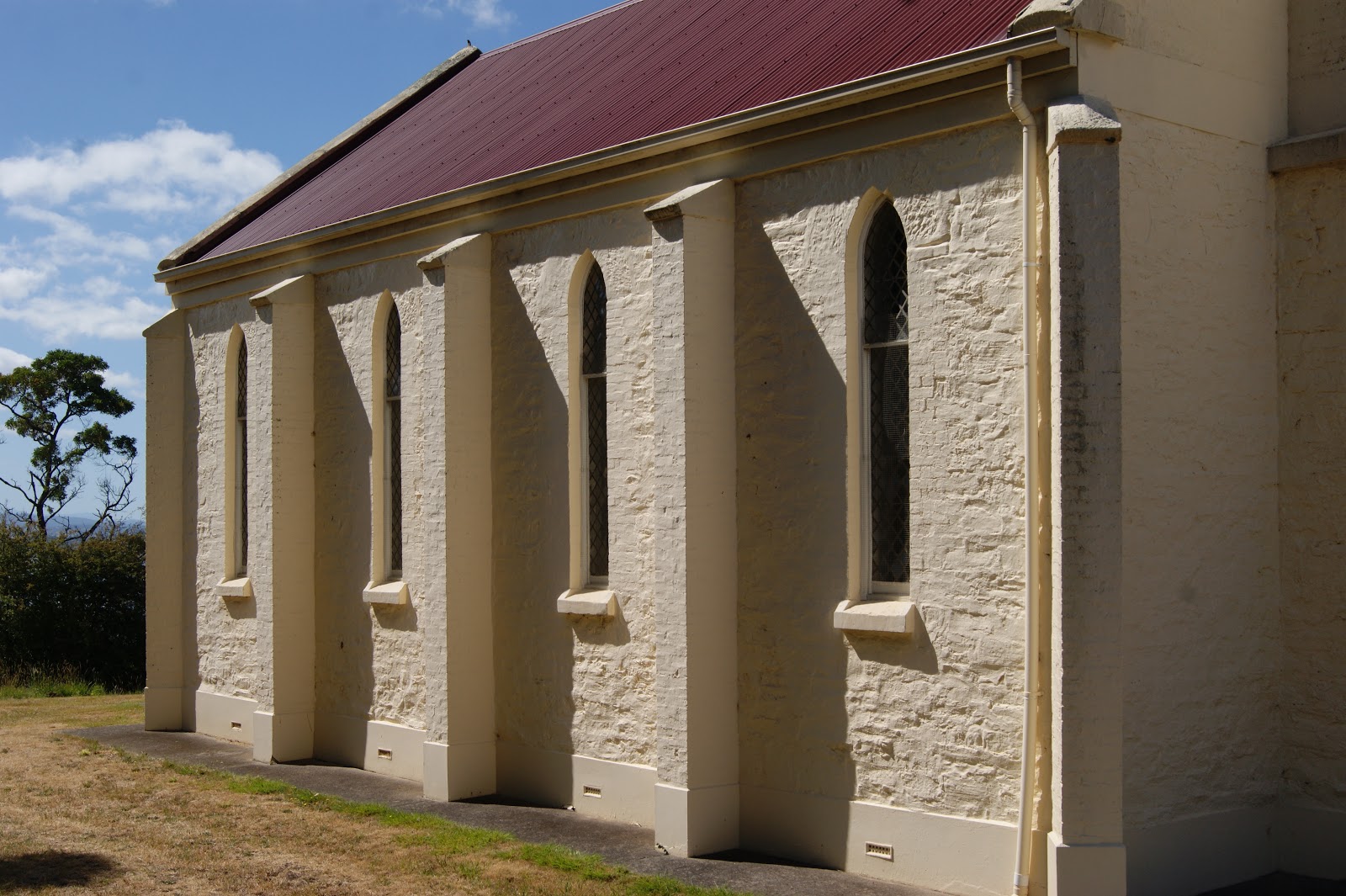
This beautiful bluestone Gothic church with its romantic history is a favorite for weddings and is very popular with photographers. The church is one of Australia’s oldest in continuous use. The building is still in its original state with no alterations or additions. This is an extremely rare quality in this day and age. The sub floor remains undisturbed and has a great deal of archeological potential. It is truly a beautiful colonial church and its tranquil surroundings provide a place of beauty and peace.
Main Text & Information Source –
St Matthias Church, Windermere Church brochure
Interior Photos –