Friday, 12 April 2013

Theatre Royal, Hobart


The story of the oldest theatre in Australia begins on the 4 April 1834. Amid calls that Hobart was too small and too poor to justify a theatre, a group of the colony’s leading citizens met to establish one. After careful planning by Peter Degraves, founder of Hobart’s Cascade Brewery, and colonial architect John Lee Archer, the first stone was laid later in the same year.

Unfortunately, the land they had bought for £280 was in the dock-side suburb of Wapping. Built near an abattoir, a soap factory, tanneries and the refuse and offal-choked Hobart Rivulet, the area must have literally reeked. The locals were not much better; poor workers, criminals and prostitutes crowded into Wapping, and were regularly visited by sailors on leave. With little to recommend the site other than availability and price, it hardly seemed the location for a grand theatre! The economic downturn of the late 1830s very nearly brought construction to a halt as shareholders withdrew their funds. One of the few left was Degraves, who effectively took over ownership of the theatre and ensured its completion.

The theatre held its first public meeting even before it was completed, when it hosted a retirement meeting for the lieutenant governor, Colonel Kenneth Snodgrass, in January 1837. Officially, it opened in March, giving performances of Speed the Plough and the Spoiled Child, lit by whale oil lamps. In June it was grandly named the Royal Victoria  Theatre to celebrate the coronation of the new Queen.

Originally, the theatre had three entries. The grand main entrance was for the gentry, while the rank and file entered via a door off a laneway that runs parallel with the theatre’s west wall. A third entrance was through a public house, built into the basement of the theatre, through which theatregoers were able to access directly the cheap seats, the pit. Though the name above the door was ‘The Shakespeare’, it was referred by one and all as ‘The Shades’. Rowdy, drunken behaviour was a common source of irritation to theatre patrons until The Shades was closed. Perhaps it is not surprising that given such a dubious reputation, plays and concert productions were more usually staged in the town hall!

In the 1850s a gallery was added to increase to the audience capacity of the theatre, now known as the Theatre Royal. However, this did not appreciably increase the number of bookings for performances. During this period, the theatre hosted almost as many cockfights, boxing matches, concerts, religious meetings and political rallies as comedies and dramas.On Degraves’ death in 1883, the theatre was sold to Richard Lewis for £3222. The new owner set the tone for the next 40 years or so, remodelling the theatre to improve conditions for actors and patrons and to meet changing fashion. When it was sold again, it was closed for a year while the stage was rebuilt and extended, and an orchestra pit added.

The most extensive modifications were started in 1911. Tiers were added, front entrance enlarged, the side entrance closed and the theatre was ornately decorated with red velvet upholstery, paintings and a beautiful crystal chandelier. This continual remodelling was unable to fend off the effects of time.
The low point came in the 1940s. Though externally the theatre still looked impressive enough, performers had to be careful not to trip in the holes in the rotting stage, and had to change in dressing rooms that were cramped, unheated, and crawling with cockroaches. The old and dangerous wiring raised the threat of fire; with no fire escapes, a blaze would have been disastrous. Unsurprisingly, the end of Theatre Royal seemed imminent. During the height of the war it was suggested that the theatre be turned into a wool store; in the post-war rush for modernity, plans were made to demolish it altogether.

The theatre’s salvation came in 1948, when the Old Vic Company gave a performance of The School for Scandal as part of its Australia and New Zealand tour. The stars, Sir Laurence Olivier and Vivien Leigh were enchanted by the gently decaying theatre. On the opening night curtain call, Oliver lent his considerable kudos to the theatre’s fight for survival. "We appreciate playing in it not only because it is a beautiful little theatre; it is more than that. Your parents and grandparents have sat here as audience. Our parents have acted on this stage. In the one hundred and eleven years it has been played in it has built up atmosphere and the secret of atmosphere is antiquity. Don’t let it go".

Olivier’s appeal to people of Tasmania worked. The state government purchased the theatre for £12,000 and promised to fund its restoration if an equal amount was raised by the National Theatre and Fine Arts Society. Fred, the Theatre Royal’s resident ghost, was used as a mascot for the restoration appeal.
The theatre was promised a highpoint when Princess Elizabeth announced that she would attend a performance in 1952. The renovations, including the hasty construction of Royal boxes, were completed on time but were never used for the intended purpose. King George VI died while Princess Elizabeth was in Kenya, and she cut her tour short to return to England.

In spite of this, Hobart now owned a splendid theatre that hosted world ranking performances and attracted impressive audiences. When a fire destroyed the stage and the front of the auditorium in 1984, another public appeal raised $1 million, and the theatre was fully restored in 1986.

The Theatre Royal is a rare example of a colonial building that continues to act the part for which it was originally cast. Its 175-year history of continued remodelling has left it a patchwork of old and new. Convict-carved sandstone lies alongside utilitarian 1970s metalwork and brick. The modern stage and red velvet seats rest above the remains of The Shades, smelling of earth, moisture and stone. A portrait of Wagner, dating from the 1911 renovations, which somehow fell into the royal box during the 1984 fire and was left completely intact, now looks over visitors entering the foyer. Without doubt it will continue to do so for many years to come


Thursday, 11 April 2013

St David's Park, Hobart


St David's Park is a formal English style walled park and dates from the beginning of European settlement in 1804. This was the site of the first burial ground in Tasmania, marked out by Lieutenant-Governor David Collins and the Reverend Robert Knopwood in April 1804.  At that time the burial ground was ‘a place of real seclusion and rare beauty’, located away from the main settlement and surrounded by an ‘exquisite natural shrubbery’.Information posted on site explains that it was called St David's Cemetery as a mark of respect to the memory of the Colony's founding Lt Governor, Lt Col David Collins. Collins himself was buried there in March 1810.  About a year afterwards the first church in Tasmania was built on the spot, with its altar directly above his grave.  However, the small wooden building hadn’t been constructed very well and within a few months it had been blown down in a storm.  Later, in 1838, Lieutenant-Governor John Franklin arranged for his predecessor’s resting place to be honored with a large sandstone monument.

The site was selected because of its discreet distance from the camp, and its natural beauty. In the 1820s it was described as 'a place of real beauty and rare seclusion' crossed by two crystal streams with fine old blackwood trees dotted through the groves of wattle on the high ground. By the 1830s it had become neglected, and was surrounded by the rapidly spreading town.

St David’s was Hobart’s main cemetery and many of its most prominent citizens were buried there.  As the town expanded, the land surrounding the burial ground was gradually developed and by the 1850s people were voicing concerns about the health risks associated with burying corpses in such a thickly populated neighbourhood.  The Government passed the Cemeteries Act in 1865 and the opening of the Cornelian Bay cemetery in 1872 allowed St Davids and all the other burial grounds within the city to be closed.

The last burial was in 1872, but the tombstones and memorials remained there and the area became very run down. A visitor in the late 1870s wrote about its sadly forlorn state, with many of the headstones defaced, or fallen down, and others covered with a rank growth of weeds. It was not closed until 1872, by which time it has become 'an odious wilderness' of weed-choked bracken and toppled headstones.

After it was closed it became a haunt for 'undesirable characters'; some with strong nerves evaded the police by hiding in collapsed graves. The idea of redeveloping the burial ground as an ornamental garden was raised in a letter to The Mercury back in April 1890, but it was to be many years before the matter was progressed.  In May 1916 the Southern Tasmanian Town Planning Association met with the Hobart City Council to lobby for all of the city’s disused cemeteries to be turned into pleasant open places for rest and recreation.

The Council endeavored to acquire St Davids burial ground but found that the church authorities were reluctant to part with it.  Finally, in late 1919, the church accepted an offer of ₤5,000 and the exchange was duly sanctioned by Parliament in the St Davids Burial Ground Vesting and Improvement Act. In 1919 it was handed over to the City Council to be used as a recreation ground. A register compiled at the time shows that at least 900 people were once buried under the lush green turf of St David's Park. Some were reburied at Cornelian Bay, most were allowed to sleep on under the now carefully-tended gardens and lawns. Now only a few of the more important memorials remain - including David Collins, first Lieutenant Governor, interred in a casket of Huon pine.

A major feature of the park is the memorial wall which is made up of many of the original headstones from the park’s previous life as the Hobart colony’s first cemetery. It contains the names and details of many “First Fleeters” and many of the early settlers of Hobart Town.

A thoughtful stroll around the park's wall of headstones gives a poignant picture of life and death in the colony's early days as there are many headstones for children from those days when children’s life expectancy was not very high. There are also memorials to those settlers who came from Norfolk Island to become part of the new settlement in 1807.

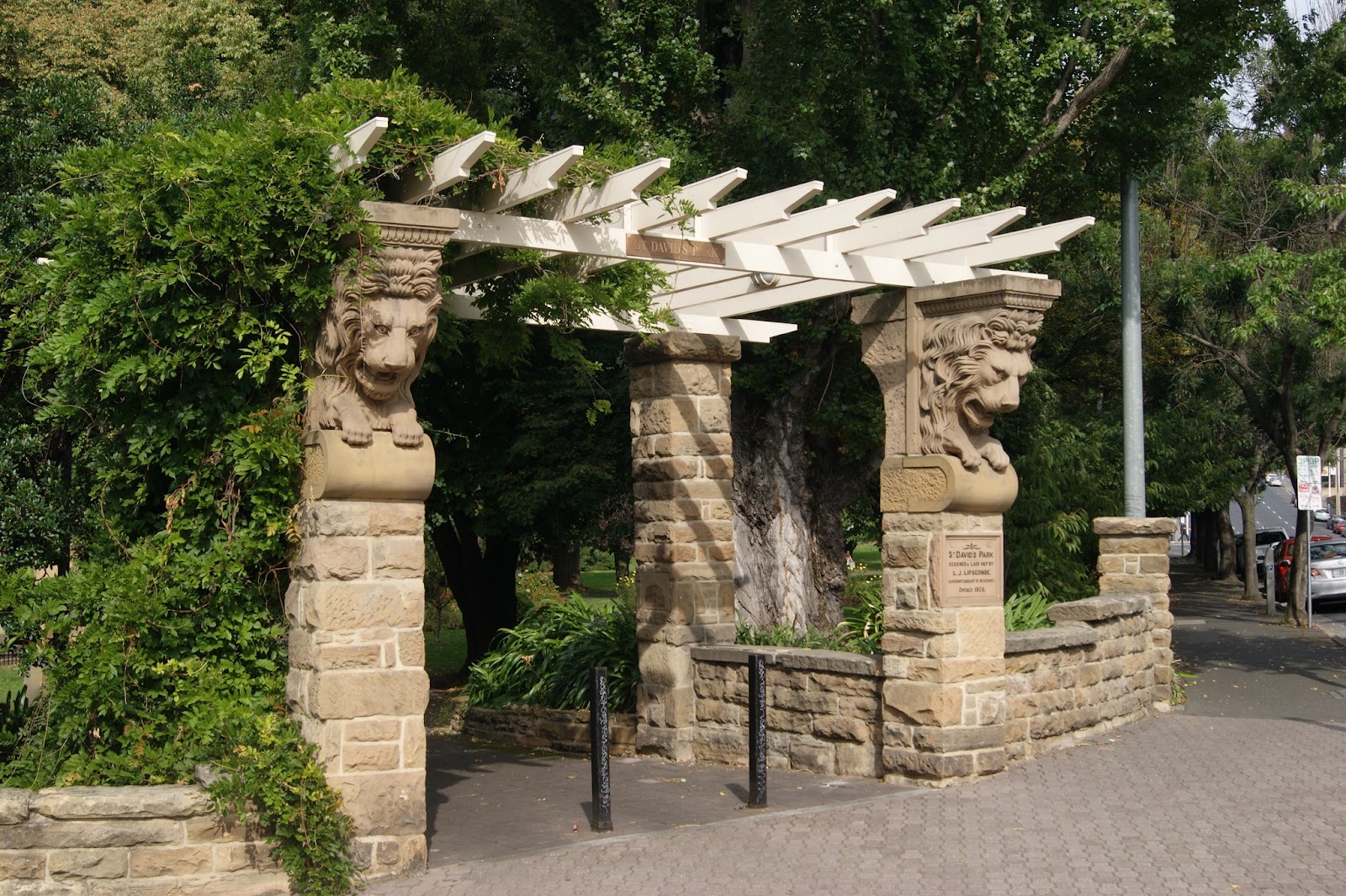
The lion sculptures at the  entrance were restored as a bicentennial gift to the people of Hobart from the Australian and New Zealand Banking Group Limited which erected them here jointly with the corporation of the city of Hobart in 1988. The lions were carved in a tent on the foot path in 1884 by Richard Patterson to serve over the entrance to the Bank of Van Diemen’s Land. The lions were then displayed at Port Arthur under the care of the Tasmanian Government until 1988.

A beautiful recreation area in the middle of Hobart and a wonderful reminder of the town's colonial past and of those early settlers who made Ol' Hobart Town what it has become today!

Tuesday, 9 April 2013

Swansea


Located 134 km from Hobart, 133 km from Launceston and 67 km from Campbell Town, Swansea sits on Great Oyster Bay and gazes across at the rugged mountains of the Freycinet National Park. It is a pretty setting and it boasts a very substantial number of historic homes and buildings which give this fishing and holiday destination a distinctive charm. Swansea is a classified Historic Town and the only historic town in Tasmania situated by the sea. This provides an ambience and relaxed feel to the town. 

The first European to explore the Swansea area was a Captain Cox sailing the brig Mercury from England to Sydney Town. He sailed up the eastern coast of Tasmania and, having heard rumour of vast colonies of seals, on 3 July 1789 sailed along the western shore of Maria Island and into a stretch of water he named Oyster Bay. He described the bay as 'being quite landlocked and sheltered from the wind in every direction.’ Cox noted that the area was already inhabited by Aborigines who, from the evidence of their middens, were obviously living off the oysters and shellfish. They disappeared into the hinterland but Cox observed smoke from their fires. Numerous sailors passed through the bay over the next twenty years but it wasn't until the 1820s that Europeans settled in the district.

Swansea was settled in 1821 when George Meredith obtained a grant from Lieutenant Governer Sorell to farm around Oyster Bay. The land was developed and made suitable for seasonal crops and grazing stock and a tannery and flour mill were established by the Meredith River. Whaling stations were also set up on nearby islands to enable the export of whale oil. It wasn't until 1827 that any sort of substantial community was established in the area. It was in that year that Captain George Hibbert of the 40th Foot Regiment established a military outpost at Waterloo Point (near the present site of the Swansea Golf Club). It was a typical military post with accommodation for the soldiers, a guard house and a commissariat. By 1830 there were 150 free residents and 170 convicts and assigned servants. The most common access from Hobart at this time was via Campbell Town. Between 1835-45, convicts worked on a road north through the mountains to Avoca and on a road south to Hobart. 

In 1831 the post office was established and in the late 1830s a number of substantial buildings - Morris's Store, Schouten House and the Black Swan Inn were all built showing an increasing prosperity. In 1850 the military garrison ( a small contingent of the 40th regiment of Foot) were withdrawn and Swansea became a police district. It remained so until 23rd January 1860 when it became the first rural municipality in Tasmania. Schools began in 1858 with 53 children in 2 schools in the area. By 1864, there were 152 pupils enrolled in state schools as well as children tutored at home. Coaches transported people and as the rough roads gradually improved people were able to move more freely. Cars gradually replaced the coaches and boat transport.

Schouten House (formerly the Swansea Inn), was built in 1844 in the traditional grand Georgian style, by William Champion of Hobart, as a wedding gift for his daughter Theresa, who married Samuel Wellard. From this point on the building has etched its place in the history of Swansea in both a tragic and a magnificent way. Several years after their marriage Theresa Wellard died and arrangements were made for a Mr. Large of Hobart to take on the inn and develop a brewery. In 1850, Mr. Large, his wife and six children aged from 2 - 12 years travelled from Hobart aboard the vessel named the Resolution. Laden with supplies and the makings of the Brewery, the family arrived in The Great Oyster Bay when disaster struck.

The following is an extract from the newspaper of the time: "Wrecks: we regret to announce a melancholy occurrence, which took place on Monday week at Oyster Bay, near Swansea. The wind was blowing high at the time: and the cutter Resolution, hence from Swan Port, with Mr and Mrs Large and the 6 children, varying in age from 2 - 12 years, and a cargo comprising articles for establishing a brewery at Swansea, on board, was totally wrecked. The whole of the goods and the lives of the six children falling a sacrifice to the elements. 

We hear that, so sudden was the catastrophe, the poor father, who was formerly a publican in Hobart Town, and has now lost all, had barely time to escape himself, and that he was insensible for several hours after being thrown on shore by surf. How Mrs.Large escaped has not correctly transpired, but a four-oared whaleboat went from town on Monday morning to the scene of the disaster". Of the Large children, all but the body of 8 year old William were recovered and buried in the town's cemetery. Stricken with grief, the parents returned to Hobart Town without taking up residency at Swansea Inn, and Mr.Wellard continued on to develop the brewery. In the mid 1850's, Swansea Inn was sold to an Alexander Graham and became a Grammar School for boys. This venture failed after 5 years and sold again, this time to a doctor, the house then became a private residence for some 80 years. The owners included the Mitchell sisters from 1897 to the 1940's and then a Bernard Hawkin. 

During this time the house was renamed Schouten House. In the early 1950's, Dominic College of Hobart purchased the house as a weekend retreat for its boys. During this time the house fell into disrepair and was finally sold in the late 1970's. After a decade of successive owners, the house was purchased by the Fiddler family and restored into a B&B and Restaurant, thus opening another chapter on the history of the building.

Meredith House was built in 1853 by J. A. Graham on land purchased from Charles Meredith, husband of noted colonial artist and poet, Louisa Anne Meredith. The first occupier was Gordon Burgess who named it Laughton House after Laughton in Essex England, from where he came. Subsequently he married a Miss Cope, a cousin of Louisa Meredith who ran it as a Girls Grammar School... and for a period it was a maternity hospital. Meredith House about 1910 - known at the time as Laughton House. 

In 1870, James Morris, the owner of Morris Store, purchased the house and in 1892 his daughter Sarah Morris started taking in paying guests. Later Sarah's niece, Maude, married Frank Morey and changed the name to Canberra Guest House. This was its heyday - a large dining room was added and it became a very popular place for holidays and honeymoons. After a marvelous dinner the rugs were rolled back and the dancing began! Stories also abound of ladies of the night entertaining the transient fishing fleet and large functions, including Christmases, with as many as 100 for lunch. Roast duck was a specialty of the House, harvested from the local flock. It was simply known as The Guest House.

The town has continued to grow and has become the most important service centre on the lower east coast as well as establishing itself as a popular holiday destination.


Monday, 8 April 2013

St John The Baptist Church, Buckland


The importance of St John the Baptist Church is partly its age - it was built in 1846 to a design by architect Crawford Cripps Wegman of Sussex, England - and its East Window. There has been much speculation about the age of the East Window with some people claiming that it was originally designed for Battle Abbey in England, a church which dates from 1094. The church building was commenced in 1846 after the local population complained to secular authorities in Hobart about the lack of any clergy to service the growing settlement of Prosser Plains. Local businessmen had pledged to select a suitable plot of land for the purpose of erecting a temporary place of worship. This became the St Georges church which is believed to have been located at the old churchyard on the opposite side of the road to the current property and was completed in 1828,

In 1840, the congregation received a grant of 25 pounds towards the erection of a new church. It wasn’t until March 1846 that the first Chaplain, Rev F.H.Cox arrived in the region to take up his chaplaincy and commence works on the new church.

By now the settlement had been renamed Buckland by the then Governor, Sir John Franklin, who named the settlement after the famed geologist, Dean Buckland. From March till October 1846, Rev Cox conducted his services at the local Police Magistrates office while the church was being constructed. The foundation stone was laid on 12th August 1846. Records of those earlier days give no account of the progress of construction of the church or as to whether it was built by free settlers or convicts. However, it is known that the church was a replica of a parish church in England, namely Cookham Dean in the Rev Cox’s native county of Sussex. Rev Cox also bought with him a stained glass window which was installed in the new church. The window itself seems to have a very storied past!

The story is that before the famous Battle of Hastings, which was actually fought at Battle in Sussex, William the Conqueror vowed that if he won he would build an abbey to commemorate his victory. Legend has it that he built the Abbey where the English King Harold II had fallen. The abbey was destroyed during the Reformation by troops loyal to Oliver Cromwell in the early 1600s. The main stained glass window from the abbey seems to have fallen into the hands of the Cecil family who had close connections with the district.
Experts believe the window in St John the Baptist Church was created sometime in the fourteenth century (some 300 years after the Battle of Hastings). The mystery of the window probably started because it is accepted that the Reverend F. H. Cox brought it to Australia when he emigrated from Sussex. One account has Lord Robert Cecil, the British Secretary of State for the Colonies, giving the window to Cox before he departed from England. Whatever the story it is still remarkable to see a fourteenth century church window in a church which wasn't built until 1846.

June 18th 1848 saw the very first service held in the new church building and on Jan 15th the following year, the Bishop of Hobart, Bishop Nixon arrived to officially consecrate the new church. The stone walls surrounding the churchyard were added at a later date. It was estimated that the cost of erecting the church, exclusive of interior ornamental features was about 900 pounds, half of which was contributed from public funds and the other half from contributions from neighborhood parishioners. 

The church is active to this day and is in amazing condition considering its age. It plays an active part in the local community and is easily visible in a prominent part of Buckland as you pass through on the Tasman Highway. The church has easy access inside where you can view the magnificent interior and view the majestic stained glass window. Historical information booklets and cards can be purchased in the church by placing your donation in the box supplied. (Honesty System applies). A beautiful little colonial church with is storied stained glass window. Well worth a visit as you pass through Buckland.


## Text & Information for this post from the booklet printed by the Parish of Buckland##
“Church of St. John the Baptist – History of Church and Window”