Sunday, 14 December 2014

Beaumaris

Beaumaris was built for Henry Llewellyn Roberts and his wife, Mary, in 1878-79.  It was situated on a two acre block of land on the eastern side of Sandy Bay Road (then known as Montpelier Road) and extended back to Newcastle Street. Henry was the founder of today’s Roberts Limited.  The company started in 1865 as an agricultural auctioneering firm.  It still operates in the farming industry but is now better known for being Tasmania’s largest real estate agency.

Henry’s wife, Mary, was interested in the welfare of animals and developed a private collection of exotic birds and native animals in the grounds of their Battery Point home.  It became known as Beaumaris Zoo but was not open to the public except during special fundraising events for local charities.  Mary is recognised as the first zookeeper to draw attention to indigenous Tasmanian fauna.  Her collection included thylacines (Tasmanian tigers) and she was the first person to breed Tasmanian devils in captivity.

When Mary died in November 1921, her daughter gave the collection of birds and animals to the Hobart City Council.  They relocated the zoo to a site on the Domain, near Government House, but it continued to be known as Beaumaris Zoo.  The last known thylacine died there in 1936 but the event attracted little attention at the time.  High running costs and falling attendances led to the zoo’s closure the following year.
Henry and Mary’s son, William Arthur Roberts lived at Beaumaris until his untimely death in April 1932.

The Roberts family offered Beaumaris for sale at auction in May 1938.  Adverts described that ‘the house is substantially built of brick and cement with slate roof, and consists of 12 main rooms, kitchen, scullery and all modern conveniences …  The garden is tastefully laid out with trees, flowers, shrubs, vegetables, etc.’  The auctioneers called attention to its unrivalled position and noted ‘the property could be easily subdivided and the house is eminently suitable for a Guest House, Private Hospital, or for conversion into flats.’

Beaumaris didn’t sell at auction but was purchased by the Defence Department in February 1939.  The Anglesea Barracks were overcrowded at the time and the proximity of Beaumaris made it the perfect overflow.  The fine old home was ‘only slightly modified’ to become the headquarters and regimental office of the 12th Mixed Brigade Signals.

The Defence Department continued to own the property until the 1990s.  The grounds of Beaumaris have since been developed with modern apartments and townhouses. In my opinion, the real shame is that Beaumaris is heavily obscured from the road by the modern apartments. But at least it is still intact and being occupied as a private residence.

Main Text & Information Source - Australian Heritage Database
Australian Dictionary of Biography - Mary Grant Roberts

Wednesday, 10 December 2014

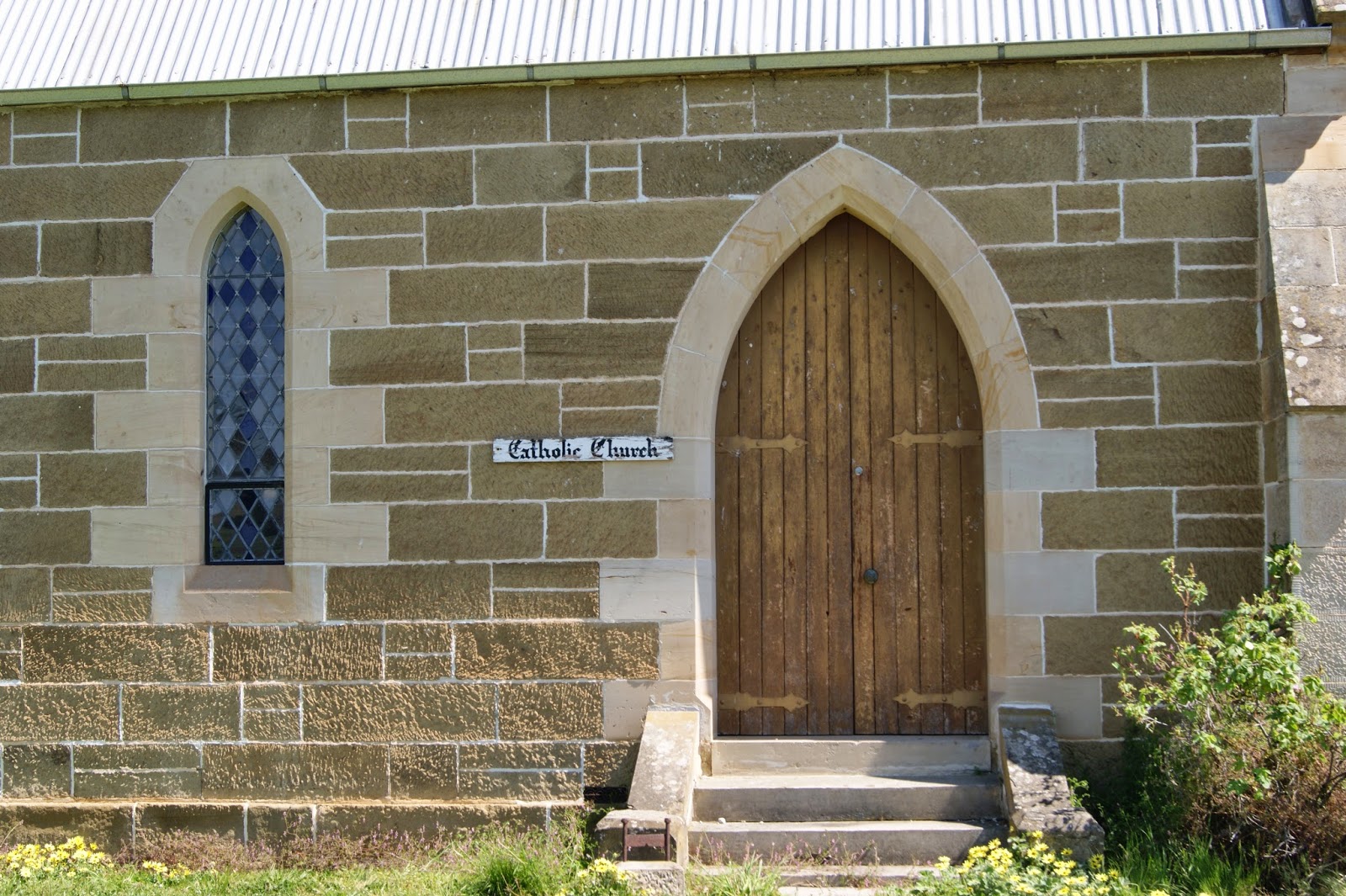
Ouse Catholic Church

The dedication for the Ouse Catholic Church on October 15, 1879, was documented by the "Catholic Standard's" reporter with great gusto. Father Gilleran of New Norfolk had made all the necessary arrangements beforehand, so a large party had left for Ouse on the 14th for the official dedication in very high spirits. All thoroughly enjoyed the wonderful spring weather and beautiful scenery up the Derwent Valley and arrived in Hamilton by mid afternoon. Following an excellent lunch, the party was back on the road to Ouse. It was said that the group could see the newly constructed church glistening in the sun for a distance of at least 6 miles.

The following day saw a tremendous turnout for the dedication ceremony, with people from Hamilton, Ellendale, New Norfolk and Marlborough all well represented. The 34 ft by 16 ft church building was declared a "gem" by all present.Thanks were given to the Honourable Walter A.B Gellibrand for his generous donation of the land on which the new church sat, to Mr Henry Hunter for his design of the new church and to Mr Lewis, who had executed his wonderful building skills in a way that could not be faulted. The diamond panel windows (which incorporated sapphire blue crosses) were considered a particular highlight of the design.

At the end of the service, it was announced that the debts for the new church stood at 100 pounds and a resultant collection around the gathering throng saw an amount of 83 pounds collected.

The church is still a "Little Gem" and is a treat for the many passers by on the neighboring Lyell Highway to enjoy. It is beautifully situated and very visible. Well worth having a wander through the attached churchyard.

Main Text & Information Source - 
"From Black Snake To Bronte" - Book by Audrey Holiday & John Trigg

Sunday, 7 December 2014

Stowellville

William Fletcher purchased three and a half acres on the southern side of New Town Bay and built Stowellville in around 1825. Fletcher had served in the commissariat department with the Duke of Wellington's army in Portugal and Spain during the Napoleonic wars. The long campaign culminated at Vitoria in Northern Spain where the French were decisively beaten. Wellington's forces had suffered about 5000 killed or wounded and Fletcher was detached from his commissariat duties so that he could assist with the tending of the wounded.

Fletcher ultimately arrived in Hobart in early 1824 to become the Deputy Assistant Commissary general and was soon living in his newly constructed Stowellville. In December 1826, Fletcher married Hannah, the daughter of Joseph Hone, the then Attorney General, who was renting the nearby Warwick Lodge. In January 1841, The Courier reported that Fletcher's friends would be gratified to know that the "worthy & zealous officer" had been promoted to the rank of Assistant Commissary general after "only 28 years of active service. In 1859, Fletcher was offered another promotion but one that would have required him to move to the Swan River Region in Western Australia so he chose to retire on half pay instead.

Because he was a senior official, Fletcher had been given a large land grant in the country but he never settled on it. He continued to live with his large family at Stowellville until his death in 1872. The property was subsequently passed on to his son, George, and later to his daughter, Margaret. She lived in Stowellville until her death in 1941.

The property is no longer a private residence and has become the headquarters of a taxi company for the past twenty or so years. The building remains in reasonable condition and remains the second oldest surviving building in the New Town Bay area, only preceded in age by Pitt Farm which is located about 100 metres further down Albert Road.

Main Text & Information Source - "The Story of New Town Bay" - Donald Howatson

Wednesday, 3 December 2014

Mimosa

This mansion certainly is one of majestic proportions. It certainly is one of the most beautiful colonial mansions in Hobart. The house is nestled at the foot of Mt Wellington, located in the suburb of North Hobart. It was originally constructed in 1879 by Dr Harry Benjafield. He was a doctor by profession, pioneered homeopathy in Tasmania, became a specialist in the cultivation of pears, tried unsuccessfully to run a dairy, imported Welsh miners to mine coal at Mt Stuart and in 1884, founded the Hobart Baptist Church in the dining room of his mansion with his wife and 17 others.

Harry Benjafield came up the hard way by working his way through Edinburgh University after a meagre education in Wiltshire where he was born in 1845. He migrated to Tasmania on the steamship, Somerset, in 1873 and he became the first homeopathic physician in Hobart Town. 6 years later, he constructed his mansion in North Hobart. It is now known by the name, Mimosa, but it didn't start life with this name.

Dr Benjafield originally called his handsome and substantial family residence, "The Willows" and it initially stood on nearly 2 hectares of land. It is built of sandstone quarried in the suburbs of Hobart and roofed with imported slate. Examples of fine craftsmanship from the period are in abundance throughout the building and modernization that have taken place over the following years have treated these examples with respect.

Once inside the front door with its red, green and blue leadlight windows on either side, you enter into a broad hall with a staircase five metres away which takes up the left hand half of the halls width. Spanning both this and the rest of the hall is an arch of finely polished wood. In its middle and set into the worrdwork is a large bronze plate with beautifully wrought initials "FB" set into a laurel wreath. This was a little bit of self immortalisation by the mansion's second owner, Frank Bond. Bond was the one who game the property it's present name.

Some of the many charming features are also still in place in the house, including the numerous fireplaces, which reveal very different designs, but in showing the best of Victorian craftsmanship in black or carved white marble. The ceilings are very high and the rooms all have a real generosity of space, both upstairs and down. There are plenty of nice wide bay windows throughout the house.

Outside, there is no sign of the original steel picket fence and ornate entry gates through which Dr Benjafield would drive his light, four wheeled buggy drawn by two fast horses as he sped off to visit someone in need.
Benjafield sold "The Willows" to Bond in 1905 and moved to his Albert Park property in Moonah. There were several changes in ownership for the renamed Mimosa in subsequent years. During the thirties, the house was used as a guest house.

The property was acquired by the Tasmanian Government in 1942 to house the Public Trustees Office and Supreme Court registry. It served this purpose until 1990 when the property was once again sold. It became corporate office space until August 2014 when the property was once again sold.

Mimosa remains in stunning condition and forms a wonderful colonial mansion precinct with Lyndhurst mansion. All the owners over the years are to be congratulated for the way the mansion has been preserved in such good condition and I sincerely hope the new owners will continue with this tradition.

Main Information & Text Sources -
“Mansions, Cottages and All Saints” – Book by Audrey Holiday & Walter Eastman
Australian Dictionary Of Biography - Harry Benjafield
Hallway Photo Source - Mimosa Hallway