Sunday, 12 June 2016

Point Puer Boy's Prison, Port Arthur

Many people are aware that convicts sentenced to the Australian colonies arrived in their greatest numbers between 1830 and 1834 – they may not be aware that between 10 and 20 percent of each ship’s arrivals were boys 10 to 14 years of age. On arrival, the prison processing called for convicts to be paraded in the barracks building in Hobart Town, approximately 30 miles from Port Arthur, for inspection by prospective employers. Signing on as prison labourers was overseen by a group of officials known as the Board of Assignment, and the Assignment Scheme was structurally part of colonial development.

However, very few boys were assigned under the Scheme; they were too small and underfed to cope with the tree-felling, quarrying, road-making and coal-mining which was an integral part of establishing the colony. The boys were left in the barracks to be imprisoned with the hard core of criminals who remained after the Assignment process. The prison authorities were concerned that the problems of the prison “mix” at Port Arthur could only worsen as there were no signs that the flow of young convicts from Britain was diminishing.

Discussions between Lieutenant-Governor George Arthur, the administrator of the colony, and the commandant of the prison, Captain O’Hara Booth, resulted in the proposal of a prison settlement for convict boys, “ to train them in some useful trade and to reform them so that they would be useful citizens”. The prison settlement on Point Puer, a promontory in Opossum Bay, Port Arthur, Tasmania, Australia, was established to cater for boys sentenced to penal servitude by the courts of England. It operated from 1834 to 1849 as part of the prison at Port Arthur. To have established a separate prison would have “been attended with additional expense”, which the Lieutenant-Governor Arthur and the British Government could ill afford.

It predated Parkhurst Prison on the Isle of Wight by four years and was initiated by Lt Governor Arthur at a time when children were being seen in their own terms, rather than as small adults. In December 1833, the first sixty boys were sent to Point Puer. Their task was to build their prison. Stories of the inaccessibility of Point Puer highlight the sixty-foot drop of sheer cliff on the western side and the treacherous currents that swirl around the Point into Opossum Bay. Only three boys were ever to successfully escape, and in more lurid writings later in the nineteenth century much was made of an uncounted number who suicided while (supposedly) attempting to escape.

The Commandant of Point Puer, William Champ, in 1834 described Point Puer as “a wretched, bleak barren spot without water, wood for fuel, or an inch of soil…”. Buildings were simple constructions hastily built between 1834 and 1840 to house rapidly growing numbers. Eventually a road was built around the fringe of Opossum Bay linking Point Puer with Port Arthur; halfway along the road, half a mile from the Point, a demarcation line separated the two establishments. The demarcation consisted of patrolled perimeter, soldiers’ barracks, two cells, two exercise yards, and two schoolrooms.

Construction at Point Puer, as at Port Arthur, was principally of Port Arthur handmade bricks, but, as there was no lime in the mortar, deterioration of the buildings was rapid. Today there is little trace above ground of the settlement of Point Puer. Best preserved are the underground storerooms of the main gaol building, which are virtually intact. There is little reason to believe that the boys who were transported to Point Puer were different in temperament to any similar group of boys today – the differences lay in their life conditions. Many were victims of the appalling poverty of British slums, or the worse poverty of British farm labour. The Executive Council in Hobart Town made few allowances for their circumstances, declaring that they were “very young, and as there is reason to believe, very depraved and difficult to manage, perhaps more so than grown men”.

This was a contributing factor to Lieutenant-Governor Arthur’s decision to establish Point Puer as a settlement for boys within the Port Arthur Prison. Another contributing factor was the five months’ sailing-ship voyage from England; this gave boys who had been convicted of what we consider today relatively minor crime, time to become expert criminals under the tutelage of their more violent older shipmates. An experiment in transporting only boy convicts on the barque Frances Charlotte in 1837 successfully set a daily program of education and activity that resulted in a skills gain from the journey and a more positive result to the final penal servitude than had previously been the case. Despite this success, the despatch of a boy-convict-only sailing ship occurred only once more, in 1838. Although the success of the Frances Charlotte’s shipboard program was repeated, the authorities never again saw fit to send a boys-only ship, and after 1845 the number of boys transported decreased to negligible proportions.

The misdemeanours for which many of the boys were transported seem trivial by today’s standards, but sentences of the period reflect the attitude of the day when punishment was meted out to the full weight of the law. Punishment was at the core of the regime at Point Puer, and severity was the keynote. “The code of punishment at Point Puer makes grim reading with its emphasis on repressive discipline and the infliction of physical pain.” It should not, however, be assumed that only “young innocents” were incarcerated at Point Puer. Many of the boys had been “schooled” in the inner city slums of London and were accomplished villains.

Older boys demanded the allegiance of younger boys through standover tactics that still exist today. Violence could be easily organised at Point Puer, especially when one recalls that many of the overseers were “ticket of leave” men, that is, convicts who had completed their sentences. The most serious crime in Point Puer’s history occurred on 1 July 1843 when an overseer was murdered by two of the boys at the prison. The end of the settlement at Point Puer was forged in the 1830s by a growing pride in the colony. A generation of native-born whites had occurred, and the Australian population saw that progress meant a move onwards from the days as a convict colony.

Even the convict labour provided by the Assignment Scheme was only welcome so long as it did not conflict with a growing freeman labour force. However the transportation system took a long time dying. In 1836, convicts and ex-convicts comprised 46.5 percent of the population of Van Dieman’s Land and this percentage grew to 52 percent by 1849.

But a depression in the early 1840s saw the formation of Anti-Transportation Leagues among the colonists and as early as 1835 Governor Arthur noted in his reports to the British Foreign Office that he had “long foreseen that abolition (of transportation) would become a popular question”. The British Government, however, still had the need to export its convicts and, well into the 1840s, there were attempts to continue to transport convicts under renamed and redevised schemes.

These “programs”, which were based on partially “reforming” the convicts at special prisons and then transporting them as “free emigrants”, resulted in a shipload of 51 boys arriving in Hobart Town in 1843 after 3 years at Parkhurst Prison in England. “From the beginning they were arrogant and untrustworthy as employees, and maintained that, as “free emigrants”, the authorities had no power over them. The worst were sent to Point Puer.”

In 1844, the “Pentonvillians”, as the colonists described the “free emigrant” adult convicts who had been “reformed” in Pentonville Prison, arrived to prove themselves similar in every way to the boys who had preceded them. Mounting public pressure from the colonists made it clear that cosmetic changes to the transportation system could no longer be tolerated and that abandonment of the scheme was essential to development and good order in the colony. The process of reining in the transportation system began.

Convict transportations dwindled over the years and convict settlements closed. On 1 March 1849, the last 162 boys at Point Puer were transferred to the work station at Cascades in Hobart Town and the Prison at Point Puer was closed. While some boys continued to offend as adults, others used their trades and pursued honest and successful lives.

Unfortunately, no buildings remain at the site, and only a few sketches were made before the establishment was demolished. There is however a comprehensive collection of architectural plans drawn by the Public Works Division, many by the convict artist Henry Laing in 1836-7. These are stored at the Port Arthur Resource Centre and the Tasmanian Archives Office.

Main Text & Information Sources 

Wednesday, 8 June 2016

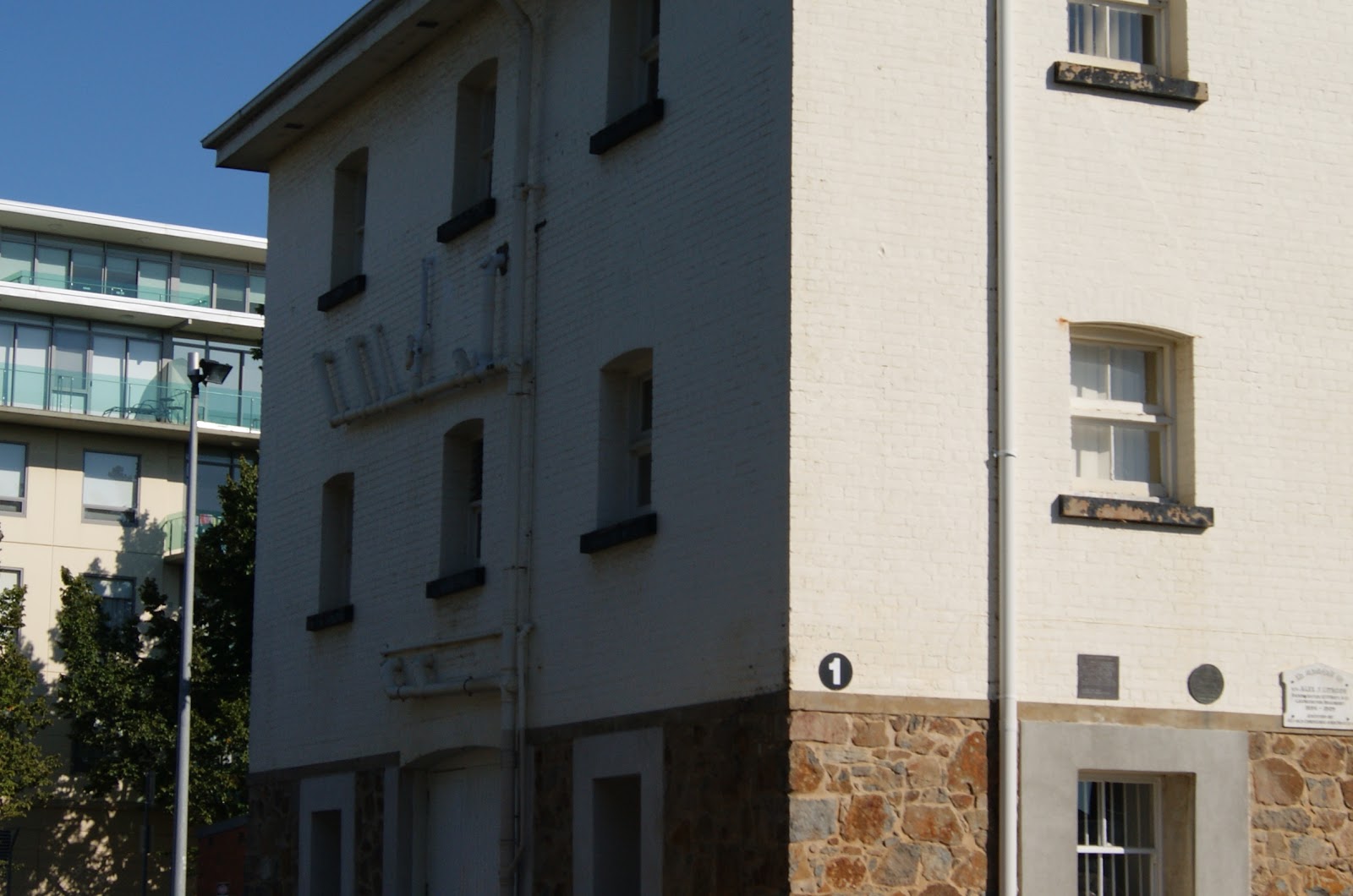
Paterson Barracks Commissariat Store, Launceston

European settlement began in northern Tasmania (Van Diemens Land) in 1804, under Lieutenant Colonel William Paterson. The first site being unsuitable, Paterson moved his headquarters to the site of present day Launceston in 1806. Although Governor Lachlan Macquarie had the main centre moved to George Town, by 1824 Launceston was the government headquarters in northern Tasmania. By this time the early commissariat building was in a dilapidated condition.

The replacement building (the present structure) was designed by David Lambe and built by contractors Robert Waddington and John Sprunt. As construction proceeded, some changes were introduced and built to designs by William Kenworthy. The Commissariat Store at Paterson Barracks dates from 1828 and is historically highly significant. The building provided food and clothing for convicts and military personnel, and was also used by the Ordnance Department and the Colonial Storekeeper's Department.

One of the oldest surviving buildings in Launceston, the Commissariat is directly associated with the early European settlement of Tasmania and the role of the government in administering the settlement, and the building's solid construction and substantial size reflects its importance in the settlement.  The Commissariat supplied food, clothing and other goods to the military and convict establishments. Although it was part of the military system, it was run by civilians. It played a central role in the development of early Launceston, a role increased by it being an agent of the British Treasury.

Further, the Ordnance Department and the Colonial Storekeeper's Department also used the building. In 1843 the building was granted to Ordnance, although by the mid 1850s Ordnance use was declining and the Colonial Government started using the Commissariat for the Public Works Department and the Immigration Department. The building remained in the ownership of the British Government, and was finally given to the Colonial Government in 1880.

Due to fears of Russian aggression, a volunteer defence force was formed in Tasmania and in 1860 the Commissariat Stores became the headquarters for the Launceston Volunteer Artillery Corps. After Federation the Corps became part of the Commonwealth defence forces. After various re-organisations, the unit today is the 16th Field Battery, Royal Australian Artillery. During the twentieth century the rest of the military allotment was developed and the whole was named Paterson Barracks in 1948.

Despite being badly damaged by fire in February 1970, the Commissariat Store remains in use and today has several functions. It houses the quartermaster's store for the 16th Field Battery on the ground floor, Defence recruiting and the officers' mess on the first floor, and offices and training rooms for the 2nd Force Support Battalion (incorporating the 10th Field Ambulance) on the second floor.

Main Text & Information Source –
Australian Heritage Database

Sunday, 5 June 2016

Wattle Hill Schoolhouse

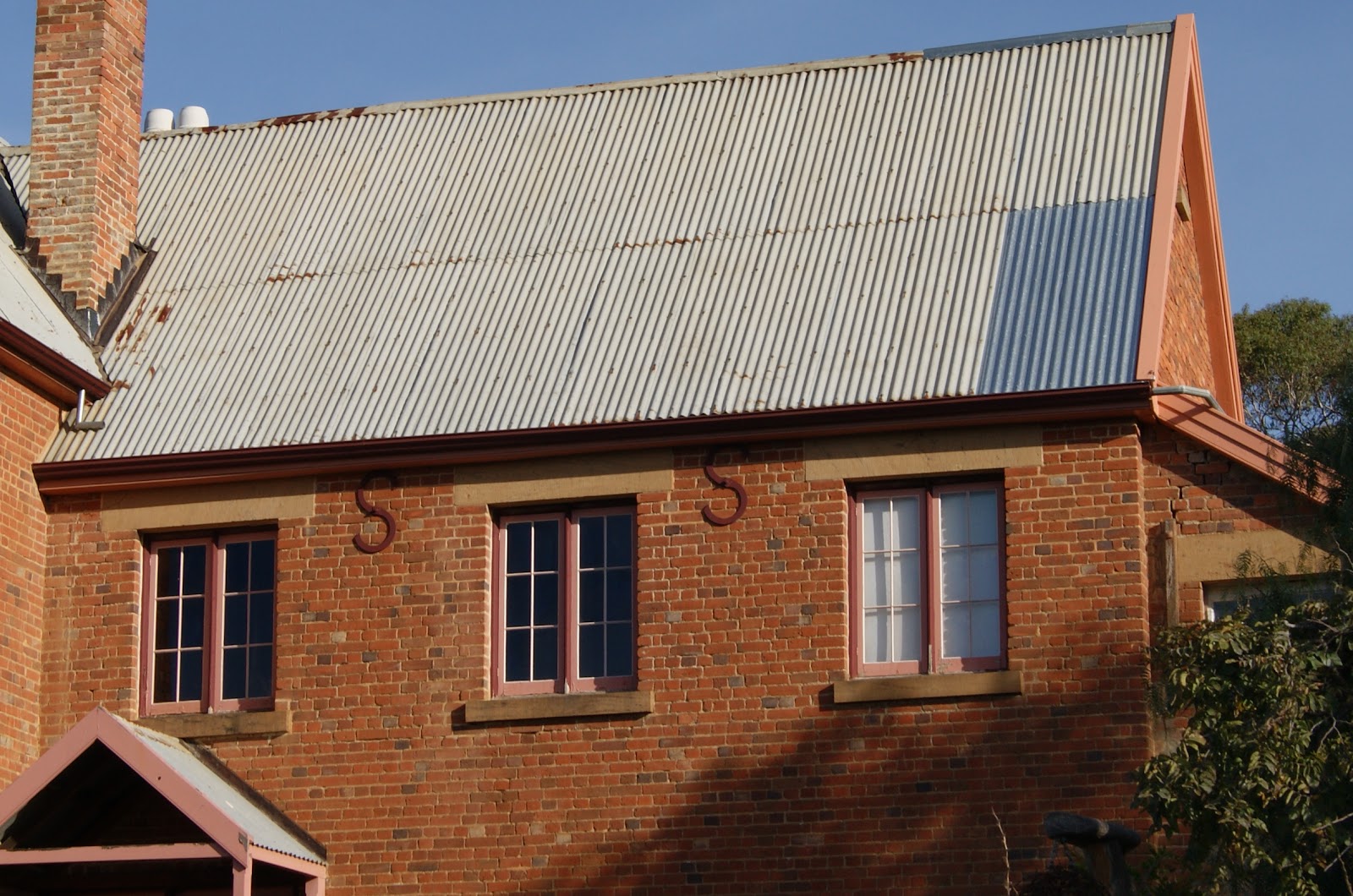
Designed by the noted colonial architect, Henry Hunter, the Wattle Hill Schoolhouse & residence was erected at a cost of about 300 pounds in 1868 on a portion of land orginally owned by Andrew Counsel. It was a “T” shaped building constructed of brick on stone foundations with a gabled roof. The schoolroom was in the stem of the “T” and the residence, consisting of two upstairs & two downstairs rooms was situated on the head of the “T”.

A report from the time concerning the new school noted: “The newly erected pretty school house and teachers residence at Wattle Hill, a delightful suburban settlement near the town of Sorell, are, under the superintendence of Mr Jonas Gatehouse, Mr John Walker Jnr and Mr Ephraim Newitt as the local committee, fast progressing towards completion. Mr R Wiggins, the builder, has been instructed to push forward the work with all speed which is what he is doing.

The carpentering is going on a pace and the painters, will have commenced the painting of the finished parts of the building and within a week or two, Mr Henry Hunter, the architect, will proceed to the place to report on the workings. There has never been a public school at Wattle Hill and the rising generation of school age pupils sufficient to be brought under the tuition of a public school master and mistress currently numbers close to 60. The opening of the school building is to be celebrated by a fete towards which, Mr John Walker has promised to contribute the handsome sum of 5 pounds.”

The school served the Wattle Hill community until 1939 when it was closed. The building remained vacant during the war years and following World War 2, it was rented out to war widows before being sold to private owners. The building has been extensively renovated and reconfigured internally and continues to act as a private residence to this day.

Main Text & Information Source – 
Sorell Heritage Study Site Inventory Vol 6 – Sorell Municipal Council

Wednesday, 1 June 2016

York Town Historic Site

York Town is the fifth oldest settlement in Australia behind Sydney, Norfolk Island, Risdon Cove and Hobart. It was settled in December 1804 under the leadership of Lt. Col. William Paterson. At its height it was home to 300 people. On the 24th May 1804 Lord Hobart wrote to Governor King of New South Wales instructing him to form a settlement at Port Dalrymple with Lt. Col. William Paterson in command. The colonization of Port Dalrymple was a strategic move to secure British interest in Bass Strait, as well as providing a further colony to accommodate settlers removed from Norfolk Island.

These were the instructions from Governor King to Captain Kent on the 1st of October 1804 “You are hereby required and directed to proceed without loss of time with H.M. Buffalo to Port Dalrymple, on the south side of Bass’s Straits, with the armed tender Lady Nelson, the Francis and Integrity. You will receive on board Lieutenant Colonel William Paterson who has been directed to embark with the civil and military establishment. It may be necessary for the soldiers to assist in the duty of the ship, as well as guard the convicts, they will be victualled with full navy rations, the woman and children of such soldiers together with convicts, will be victualled at two- thirds allowance, without spirits".

On the 8th of June 1804 Col. Paterson departed New South Wales only to turn back 11 days later due to the severity of winter gales. On the 15th of October Paterson again sailed out of Sydney Harbour bound for Port Dalrymple. Heavy gales were encountered as they plied there way south. The ships became separated and it was the Buffalo that sailed into Port Dalrymple on the 4th of November followed by Integrity on the 5th and the Lady Nelson and the Francis on the 21st.

A letter dated 26th of November from Lieutenant Governor Paterson to Governor King. Colonel Paterson writes of the camp at Outer Cove. He talks of the examination of the harbor as far as Swan Point. He states that he has lodged some stores under guard on Green Island and that dry stores are lodged in a well thatched hut near his own house until a better building can be erected.

On the 11th His Majesty’s Colors were hoisted with the usual Ceremony under Royal Salute from the Buffalo. The next day they proceeded to clear ground for temporary buildings and cultivation. Paterson stated that he had made several short excursions in the vicinity of the Cove but had not yet discovered anything to recommend it as a permanent situation. However the area was convenient for the receiving of stores and if the run of water continued all year there may be 100 acres fit for cultivation and pasture for a few cattle.

In the same letter Paterson talks of his appreciation of Captain Kent. He had organised the laying of beacons and the erection of a Flagstaff at Lower Head which would make entering the Port much safer. Kent had also made several important discoveries, lime stone and free stone for building and at the head of Western Arm two fine runs of excellent water one which he named Kent’s Burn (York Town Rivulet), the other McMillan's Burn, (Massey’s Creek). Paterson stated that he had visited the site and at the time it appeared to be the most eligible situation for the seat of government.

On the 27th of December, in a letter to Governor King Paterson writes that on the 28th of November he embarked on board the Lady Nelson with Ensign Hugh Piper, Mr. Mountgarrett, a Corporal and five soldiers to proceed up the River for the purpose of exploration and evaluation. He would then report his findings to the Governor. Paterson found that the country in general exceeded his expectations in respect to fresh water and good soil.

On the 15th of December Paterson revisited Western Arm wishing to be satisfied with respect to its situation. It was still his opinion that the head of Western Arm was the most eligible situation for a permanent residence. At this time he named the area Yorkton (York Town) and the hill to the right Mount Albany.
The explorers then continued on to Lower Head. Paterson found a large Lagoon. This area was convenient for the landing of cattle and the pasture so excellent that it induced Paterson to continue Outer Cove as a Port.

On the 17th of December Paterson marked out the ground at York Town for the erection of Quarters and had the Prisoners employed in the embarking of the two wooden houses and other stores on board the Lady Nelson and Francis. Part of the stores and working hands were then transported across from Outer Cove to York Town to enable buildings to be erected before the winter season began. In a letter from Governor King to Paterson dated 28th of January 1805 Governor King commented on the selection of the site for the new settlement. He concurred that Paterson would be the best judge of the most eligible place for the principle settlement and securing the best situation for Settlers. Governor King also writes of the advantages Paterson had stated respecting Western Arm, which pointed it out to be the most eligible place for the headquarters. In addition he approved of the name given to the intended town as well as the district.

Paterson wrote to Governor King on the 8th of January informing him of his preparations for removal to York Town. He had employed three soldiers (carpenters) to assist in the building of temporary quarters before he moved the military from the Cove. An area of better than forty acres had been cleared between the two runs at Western Arm, which would soon be burnt off to prevent any accidents by fire happening to the huts, as these were to be thatched for the present. As soon as this was achieved he intended to employ all hands to erect a strong log house for the stores. This done, he removed most of the detachment from Outer Cove to prevent any criminal activities taking place.

In a letter to Governor King dated 21st February 1805 Paterson writes of a short excursion from the settlement at Western Arm on the 9th of February. He mentions finding blackwood and wattle the only wood as yet found useful for shingles. He also states that he has discovered sassafras growing in considerable quantities and fit for many purposes. The best being for house building and boats.
Paterson also writes of problems he is having with a species of ant that has been eating the leaves off the plants of grains and oats in his garden at Outer Cove, but adds, that at Western Arm, he did not have any problems with insect pests eating the vegetables. He was however concerned about the abundance in number of small rat like quadrupeds between the two burns. These had been eating the potatoes, french beans and other large seeds.

In the same letter Paterson discusses the store at Western Arm that he hopes to start building immediately. He proposes that it will be logged and shingled and of sufficient dimensions. He comments that Palmer's Mill may be of great acquisition. In March 1805 William Paterson’s wife Eliza joined him. Both she and her servant Hannah (Ann Williams) sailed from Port Jackson on the Buffalo.

On the 14th of November 1805 Paterson wrote to Earl Camden recalling the past twelve months He felt that the greatest part of the difficulties had been surmounted. The stores were well secured in substantial buildings, all of the officers had houses, the detachment was in good huts and the prisoners were comfortably sheltered.  On the same date Paterson wrote to Governor King. In regards to public buildings he felt he had done as much as possible and intended to go on with brick making through the summer when he hoped to have a substantial jail built. At that time there was a small brick one well secured behind the Guard House paling. A public oven was also erected.

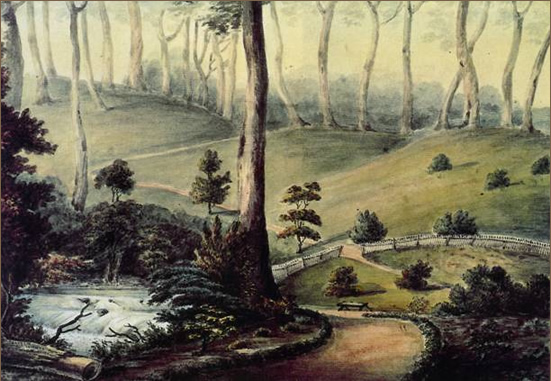
Paterson had also established a government gardens with fruit trees, ornamental plantings and a summerhouse. It was situated around a small waterfall on the York Town Rivulet. Then Paterson faced major concerns although the settlers worked hard they were faced with many problems. When the cold of winter set in their cattle began to die in large numbers, crops failed and food supplies diminished and morale was low. Food shortages had plagued the fledgling settlement from the outset. Robberies of the government stores and sheep stealing were common occurrences. The situation escalated in June 1806 when the ship, Venus, carrying valuable rations, was seized by a soldier, convict pilot and first mate.

During Paterson’s absence of over seven months to attend to military business in Sydney, the settlement descended into chaos. He returned in April 1807 to find that many farms had been abandoned and the inhabitants had taken to “wood ranging” hunting kangaroos to survive. Several convicts had absconded and were living like “desperate and dangerous bandits”  Good grazing land, fresh water and an excellent deep water port were some of the things which prompted Paterson to propose a move to more fertile plains near the Cataract (the present site of Launceston).

On the 27th of September 1807 Governor Bligh wrote to Paterson concerned at the distribution of convicts - forty-two at York Town and fifty-four at Launceston. He was distressed at the lack of permanent Headquarters and Paterson’s inability to supervise the people under his control. Although Launceston became the principle settlement in the north Paterson continued to live at York Town until 1808. By 1809 over 300 acres were in cultivation at the new location, which was fast becoming established. In contrast, York Town was largely abandoned. When Governor Macquarie visited from New South Wales in 1811, he found only a few houses remaining.

Convict gardener, Harry Barrett, stayed on in York Town to tend the gardens, along with some soldiers to guard the stores. Barrett and his family were among the few residents to live in York Town after its official closure. In February 1895, a reporter from the “Tasmanian” newspaper paid a visit to York Town and on arriving at the site, stumbled across an old tumble down shed, two small wooden cottages, each surrounded by a garden and the ruins of an old cemetery. James Barrett, the son of Paterson’s convict gardener, Henry Barrett, spoke to the reporter at length about his father and what he had told him about the early days. He pointed out the remains of the old cellar of the Governors’ cottage, the location of the officer’s quarters and the old prisoner’s camp. The reporter concluded “There is little known of this sequestered spot and the present generation has not troubled itself with much to unravel the story which so intimately binds itself with the past. The story, however, is one every Tasmanian should know…”

York Town lays claim to being the first declared permanent settlement in the north of the state. In its heyday boasting many residences set in Botanical Gardens some of these included Lieutenant Governor Paterson’s house, Soldiers Barracks, Guard House, Store and many dwellings some built with bricks made on the site. The settlement had a substantial population set in an area of 40 acres. The Cemetery is no longer recognizable and like its inhabitants some of the town still remains buried underground but occasionally remnants make their way to the surface to remind us of a past that has been forgotten.

Renewed interest in the history of York Town came from members of the Royal Society and Scenic preservation Board in the 1950’s. Several allotments were acquired by the government and a monument was erected in Nov 1954 to mark the sesqui- centenary of the original settlement. Further allotments have since been acquired and the site has been developed as a historic attraction.

Recent archeological investigations organized by the West Tamar Historical Society have revealed interesting facts about the construction of the original buildings and about the everyday lives of the inhabitants.
York Town is without a doubt a valuable historical site of national importance.

Main Text & Information Source –
York Town Historic Site brochure